What is an Agentic Risk Intelligence Platform? Why Do You Need One?

By Jen Snell
Artificial intelligence is evolving every bit as quickly as geopolitical events and threats are developing. While government agencies and enterprises may find it daunting to leapfrog from legacy threat-detection and screening tools to agentic AI platforms, it is vitally important they do so.
Because the bad guys are.
Nation-state adversaries, organized criminal networks, and even lone-wolf actors are using AI to move faster, hide better, and scale their operations. They are accelerating disinformation campaigns, manufacturing synthetic identities, probing supply chains, and conducting influence operations at speed and scale that legacy risk and investigative approaches cannot match. As a result, hostile acts far outpace the siloed, manual investigative techniques used across both government and commercial enterprises.
If you are a practitioner or lead intelligence, security, risk, or compliance analyst in national security or a global enterprise, you already know this. You’ve deployed tools to find and monitor these threats. But those tools are insufficient to the task.
The rest of this blog will examine the technological shortcomings that plague investigative processes, and the new platforms that can help overcome them.
Stumbling blocks on the road to intelligence
Three aspects of the current risk detection environment stymie investigations. These are the:
- Disjointed nature of legacy threat-detection tools
- Limitations of early generative AI
- Chaotic nature of the data on which investigations are based
Specialized threat-detection tools currently in use address specific situations — suspicious movement of people or vehicles, communications indicative of espionage, missile tests. But they too often operate in silos that fragment data and obscure insight. As a result, analysts can miss the critical connections that spotlight emerging threats or expose hidden vulnerabilities.
A weather forecast may tell you that a monsoon will cause flooding and landslides in Kashmir. A situational awareness report may indicate an uptick in troop movement along Pakistan’s northeastern border. But nothing connects the dots to indicate that Pakistan could use the severe weather as cover for infiltrating Kashmir.
The same blind spots exist in the enterprise. A sanctions desk may flag a newly designated entity. A procurement team may note that a critical supplier has quietly changed ownership. However, nothing connects the two to reveal that a key vendor has just come under the control of a sanctioned party until the transaction has already cleared.
Early generative AI can’t keep up
“Reactive” AI — the type of AI now used in some government agencies — requires significant human intervention. This intervention slows time to insight.
Reactive AI works like this. An investigator develops a prompt: “Summarize drone imagery from Zone X.” The AI summary indicates that groups of people now stream onto previously undeveloped acreage. The analyst wants to know more. He develops a new query. The system responds with information indicating the commencement of a large construction project on this site. The analyst, worried about the possibility of restricted materials being delivered there (radioactive materials, narcotics precursors, explosives precursors), poses more questions to the AI system. Step by step, human interrogation is needed to obtain insight. The reactive AI system essentially works like a smart chatbot. A financial crime or due diligence practitioner confronts the same challenge when every adverse media hit, ownership query, or sanctions check is a separate, manual prompt. This creates one rabbit hole at a time, dozens of open cases deep.
Undercutting both legacy software tools and early-gen AI systems is chaotic, decontextualized data. This data can provide only opaque intelligence.
The publicly available information (PAI) searched by AI is fragmented across thousands of sources and hundreds of languages. Social media platforms and shipping information. Commercially available datasets and the dark web. Vehicle telemetry and cell site location information. PAI is created and stored with little or no connection among data points. Defense and intelligence agencies are therefore left with muddled data rather than verified intelligence.
The solution: agentic AI platforms powered by world-class data
To obtain deeper insight as quickly as possible, government agencies, defense organizations, financial institutions, and critical infrastructure operators need to transition from threat detection tools and intelligent chatbots to agentic AI risk platforms built on Data Advantage.
What is agentic AI? It is artificial intelligence capable of undertaking complex, multi-step tasks without the need for consistent human intervention or interrogation. Let’s return to the drone imagery scenario. Using existing AI, an analyst can ask this system to “Summarize drone imagery from Zone X.” With an Agentic Risk Intelligence platform, the analyst can order the system to “Maintain situational awareness in Zone X.” The best of these platforms will then continuously ingest, refine, correlate, and contextualize data (imagery, signals, field reports, and more). It will update the analyst as situations evolve, integrating insight into operational workflows and prioritizing alerts in alignment with mission objectives.
These platforms are especially valuable across three core risk domains: global events, identity, and suppliers/vendors. Together, these domains help organizations understand what is happening, who is involved, and where exposure exists across people, organizations, regions, and supply chains.
- Global and event risk intelligence helps organizations detect emerging threats across the global digital landscape before they escalate into operational, physical, reputational, or security risk. This includes geopolitical instability, regional conflict, executive and facility threats, cyber activity, public narratives, event risk, and emerging indicators of violence or disruption.
- Identity risk intelligence helps organizations uncover hidden risks tied to people, surfacing undisclosed affiliations, adverse media, sanctions exposure, and integrity concerns beyond what individuals disclose. Whether the question is clearing an individual for trusted access or screening a customer at onboarding, it fuses multilingual, multi-source data into a single, defensible picture.
- Vendor risk intelligence helps organizations continuously monitor vendors, suppliers, third parties, and counterparties for ownership, operational, sanctions, foreign influence, cyber, and supply chain risk. Whether the relationship is a cleared contractor under FOCI review or a critical supplier in a global enterprise, this is essential for protecting government missions, financial systems, national infrastructure, and enterprise continuity.
Across all three domains, agentic AI platforms help analysts move beyond disconnected alerts and manual research. They ingest and correlate multilingual data, resolve entities and map networks, surface anomalies, prioritize risk, and deliver connected intelligence early enough for organizations to act.
Why Babel Street?
Babel Street has spent more than a decade serving the military, defense, and intelligence communities — providing AI and open-source intelligence based on world-class data. That experience and expertise have shaped the Babel Street Agentic Risk Intelligence Platform. Setting a new standard for threat detection, this platform helps organizations outpace dynamic threats by providing panoramic, up-to-the-second insight into geopolitical risk, along with insider threats and supply chain vulnerabilities.
The platform is an AI-native operational framework in which governed AI agents execute tasks needed to find, synthesize, and deliver structured, decision-ready intelligence. Human authority is preserved at every step.
The platform offers:
Elite tradecraft
The platform’s agentic investigative capabilities are modeled on real-life techniques and proven workflows developed by expert practitioners. With Babel Street, human investigators and analysts retain control of investigative objectives, pathways, scopes, and outcomes.
Data Advantage
The Babel Street platform is underpinned by our pipeline of rights-cleared, mission-curated, multilingual data, including both text and images that other providers can’t access or replicate. Data is culled from information published in more than 200 languages. Our entity extraction capabilities structure data at ingestion, improving search precision and enabling more consistent, evidence-backed analyses.
Agentic execution
Rather than merely returning chatbot-like answers to queries, Babel Street delivers a coordinated system of intelligence-trained agents working in tandem to orchestrate discovery, synthesis, challenge, and reporting to move from a single request to a finished, multi-step investigation at machine speed.
Governance, trust, and transparency
Unlike black-box AI systems, Babel Street can delineate its own research plans, query logic, and reasoning. It provides citations for data examined, along with data provenance. In doing so, the platform provides audit trails and other types of traceability that satisfy regulators, leadership, and stakeholders.
The result? In an uncertain geopolitical climate and rapidly changing risk environment, the Babel Street Agentic Risk Intelligence Platform enables mission operators and risk leaders to make the type of fast, fully informed, and defensible decisions needed to build a safer world.
Disclaimer
All names, companies, and incidents portrayed in this document are fictitious. No identification with actual persons (living or deceased), places, companies, and products are intended or should be inferred.
Published
Related Resources
You may like

AI-Powered Risk Intelligence Helps Modernize AML/KYC Investigations
AI-powered risk intelligence solutions help FIs analyze complex AML/KYC data faster, reduce manual friction, and make more confident compliance decisions.

Turn Visual Content into Investigative Intelligence

Exceeding Human Potential with Agentic Investigations
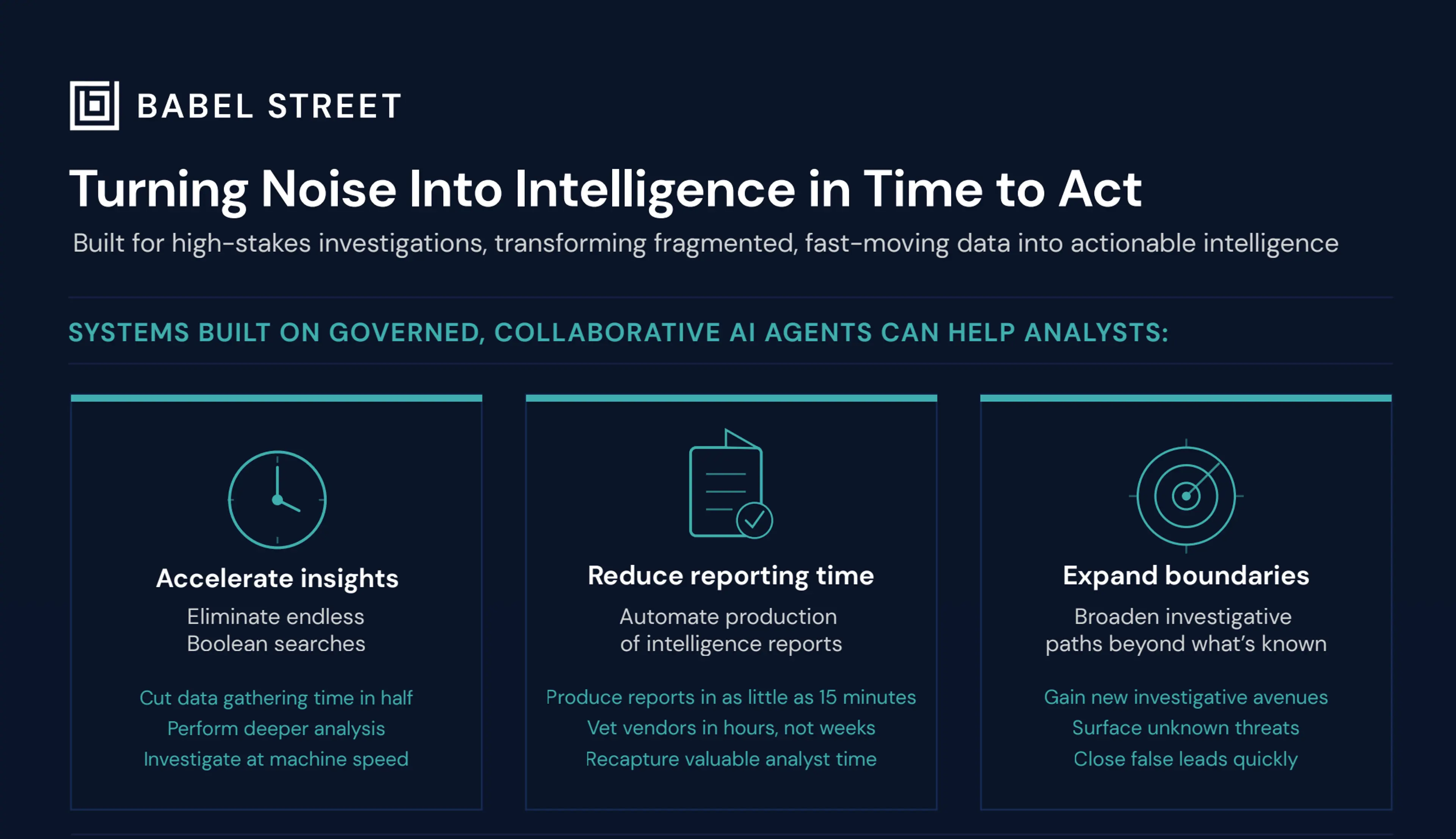
ノイズを迅速に意思決定につながるインテリジェンスへ変換
重要な意思決定を支える調査業務向けに設計。断片化し急速に変化するデータを実行可能なインテリジェンスへ変換します