Uncovering the Truth: Using AI and OSINT to Catch Insurance Fraudsters
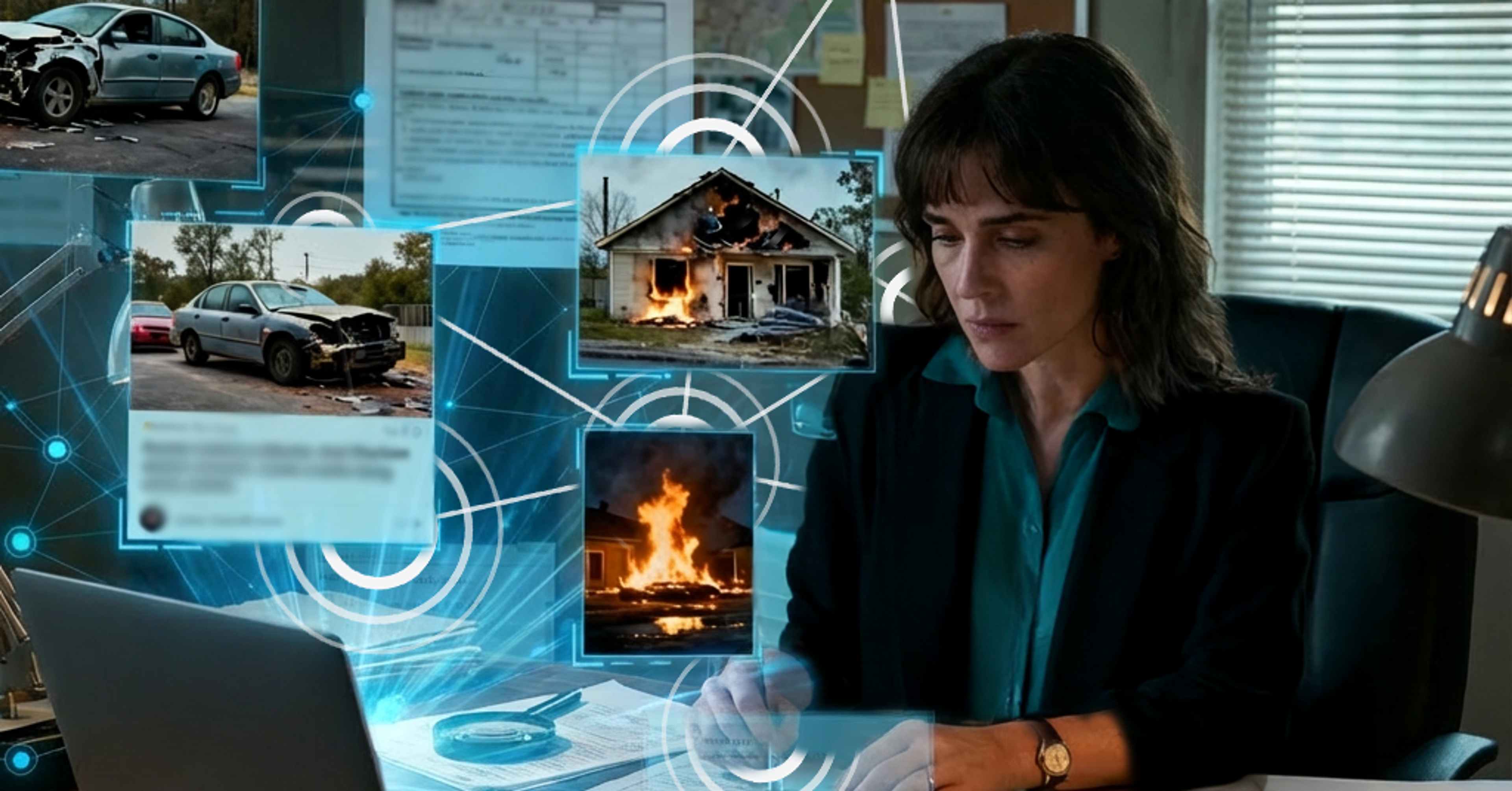
In the United States, about 20% of all insurance claims are believed to be fraudulent.[1] This crime costs insurers roughly $308.6 billion annually.[2] Insurers pass these costs on to policy holders. USI Insurance Services estimates that fraud increases premiums by about $900 per policy per year.[3]
At more than $105 billion annually, medical claims fraud (including Medicare/Medicaid fraud) proves most costly.[4] Costs for auto insurance, homeowner’s insurance, and workers’ comp are also significant.
Digital advancements provide new vectors for these crimes. Increasingly, fraudsters coordinate operations online — planning staged auto accidents, for example. They work with invoice generators to create fraudulent workers’ comp bills or auto repair estimates. They employ information culled from data breaches or phishing schemes to file fake claims under someone else’s name.
These technological advancements have led to spiraling instances of fraud. Thirty-five percent of the insurers interviewed in the Reinsurance Group of America’s “2024 Global Claims Fraud Survey” reported year-over-year fraud increases.[5]
Insurance company investigators and analysts are charged with detecting fraudulent claims and preventing unmerited payments. It’s an overwhelming task.
How to fight back? Open source intelligence (OSINT) — or insight gleaned from the automated searching, collating, and analyses of publicly and commercially available information (PAI/CAI) — can help investigators detect fraud.
AI-powered risk intelligence platforms provide this intelligence through a social media monitoring, also known as “social discovery.” This capability surfaces social media chatter and posts indicative of fraudsters at work. Beyond social media, these platforms also scour additional types of PAI/CAI for fraud indicators
How it works
Incredibly, fraudsters often brag about their crimes online — typically inadvertently. Very few people publicly boast, “I defrauded the workers’ comp system today!” However, they will post sentiments telegraphing the fraud. A person receiving workers’ compensation typically should not be well enough to enjoy a water-skiing holiday. If he posts about the joys and challenges of a deep-water start, insurance companies may take this contradicting evidence as a fraud indicator. Ditto for a claimant who reports the theft of a $10,000 diamond ring, only for that same person to post a very similar ring for sale in an online marketplace. Social media monitoring can help investigators spot these fraud indicators.
Risk intelligence platforms also help insurance companies search other types of PAI/CAI. This data includes court records, business filings, real estate records, professional licenses, government and regulatory data, mainstream media sites, and more. How can these searches help detect fraud? Court records may indicate that a single claimant has filed six slip-and-fall personal injury lawsuits. Business records may indicate that the owner of a contracting company charging higher-than-average prices for post-hurricane renovation is related to the homeowner. And location intelligence may indicate that an unusually high number of car accidents happen at the corner of Elm and Main streets — a possible indicator of crash-for-cash rings at work.
Fraud and theft: A team effort
Not all fraud is a one-person crime. Fraudsters often operate in organized rings. Consider medical claims fraud, which often involves “patients,” doctors, and other medical-services providers working in tandem. To pierce these rings, the best identity-risk intelligence platforms map social media networks — uncovering hidden connections, relationships, and intersecting activities.
Like fraud rings, theft rings can also hurt insurers’ businesses. After a series of videos appearing on social media showed how easy it was to steal a certain make and model of automobile, thefts of those cars by gangs skyrocketed.[6] Meanwhile, according to the National Insurance Crime Bureau, cargo theft in the United States increased 27 percent from 2024 to 2025.[7] These thefts are often committed by transnational organized crime rings bidding on contracts online, cloning vendor identities, and rerouting shipments.[8]
Social discovery can alert insurers to the existence of these and other types of rings. Insurance companies can then provide information to their clients on how they can protect themselves from thieves.
How Babel Street can help
The mission-focused, AI-powered Babel Street Risk Intelligence Platform provides always-on monitoring of thousands of sources of PAI/CAI — automatically alerting investigators when information is found. In these searches, Babel Street detects both the everyday language and code words used by fraudsters, along with other indicators of nefarious activities. Unique to the industry, Babel Street can search information published in more than 200 languages, then translate results into the user’s language of choice.
Babel Street further enhances investigations through searches of the deep and dark web — or web sites that are inaccessible by standard search engines. Because the nature of the tools used to access the dark web ensure anonymity, it is a hotbed of illegal activity — including insurance fraud-ring and theft-ring communications. Deep- and dark-web search capabilities enable investigators to quickly and efficiently find information they wouldn’t otherwise be able to access.
Babel Street searches are anonymous, and the platform also provides managed attribution capabilities that enable insurance company investigators to access and analyze online sources without risking their organization's infrastructure or compromising their own identities. In addition, Babel Street’s hardened proxy network ensures in-country access to sites around the world.
To crack fraud rings, Babel Street offers automated social network and relationship mapping, examining hundreds or thousands of relationships within a specific network or discussion group. Our platform uncovers previously unknown or hidden connections and identifies those participants who wield the most influence. Advanced visualization tools clearly display complex networks and relationships. This graph-powered clarity empowers users to explore connections among entities, uncover hidden links, and gain a comprehensive understanding of organizational structures.
The digital arena provides criminals with new opportunities for planning and committing insurance fraud and other types of theft. The right risk intelligence platform can help insurance companies protect themselves and their policyholders.
Endnotes
1. USI, “Insurance Fraud: How Policyholders Pay the Price,” June 2025, https://www.usi.com/executive-insights/executive-series-articles/featured/personal-risk/q2-2025/insurance-fraud-how-policyholders-pay-the-price/
2. Kilroy, Ashley, “Insurance Fraud Statistics 2025,” Forbes.com, January 2025, https://www.forbes.com/advisor/insurance/fraud-statistics
3. USI, “Insurance Fraud: How Policyholders Pay the Price,” June 2025, https://www.usi.com/executive-insights/executive-series-articles/featured/personal-risk/q2-2025/insurance-fraud-how-policyholders-pay-the-price/
4. Kilroy, Ashley, “Insurance Fraud Statistics 2025,” Forbes.com, January 2025, https://www.forbes.com/advisor/insurance/fraud-statistics
5. Reinsurance Group of America, “2024 Global Claims Fraud Survey,” accessed November 2025, https://experience.rgare.com/globalclaims-fraudsurvey-2024/p/1
6. Wikipedia, “Kia Challenge,” accessed January 2026, https://en.wikipedia.org/wiki/Kia_Challenge
7. National Insurance Crime Bureau, “Cargo Theft,” accessed January 2026, https://www.nicb.org/prevent-fraud-theft/cargo-theft
8. Lewis McFate, Jessica, “Is Your Vendor Real? How to Spot a $1M+ Fraud Before Your Cargo Disappears,” Industrial Equipment News, November 2025, https://www.ien.com/supply-chain/article/22954289/is-your-vendor-real-how-to-spot-a-1m-fraud-before-your-cargo-disappears
Disclaimer
All names, companies, and incidents portrayed in this document are fictitious. No identification with actual persons (living or deceased), places, companies, and products are intended or should be inferred.
Published