
What Is Qualified Intelligence Data?
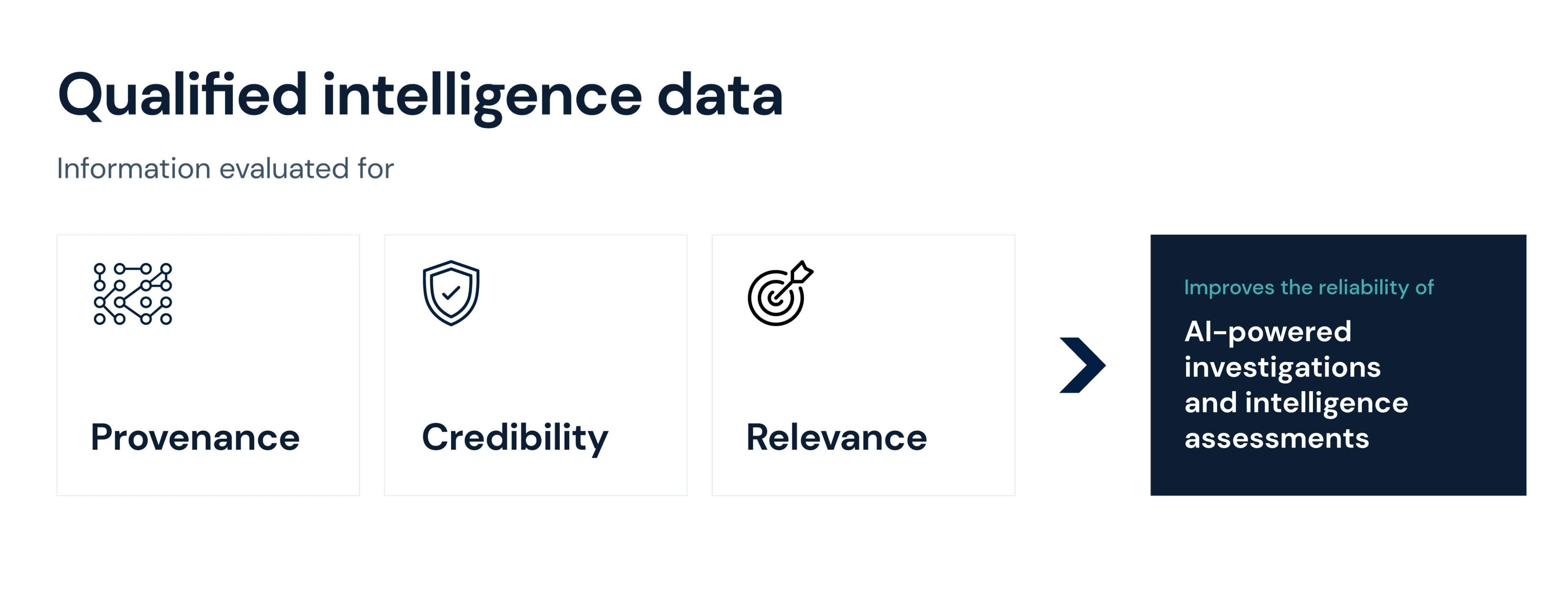
Qualified intelligence data is information evaluated for provenance, credibility, and relevance before being used in intelligence analysis. These three criteria underpin intelligence data quality: they help analysts distinguish trustworthy information from misinformation, outdated records, manipulated content, and unrelated data. By preserving source context and supporting verification, qualified intelligence data improves the reliability of AI-powered investigations and intelligence assessments.
Garbage in, garbage out.
That saying dates from the Mesozoic Era of computing — the days of punch cards and card readers. It holds true in the age of AI.
Too many AI-powered investigative platforms base their conclusions on unreliable data, leaving the intelligence community (IC) — along with other government and military organizations — unable to distinguish valid threat signals from irrelevant noise. As a result, the IC too often obtains incomplete insight into adversarial behavior, emerging threats, and global events.
The Babel Street Agentic Risk Intelligence Platform generates insight from a vast pipeline of data and contextual signals evaluated for provenance, credibility, and relevance called the Babel Street Data Advantage™. In doing so, it helps agencies receive and maintain a decisive information advantage, and detect emerging threats before they morph into imminent risks.
The value of qualified data for AI-powered intelligence
“Qualified content” consists of data and additional materials — photographs, videos, and other media — that have been evaluated for provenance, credibility, and relevance. Without this evaluation, insight can be both fully grounded and wrong. Why? The source data itself was bad: synthetic, misleading, stale, manipulated, taken out of context, or published by unreliable sources.
AI-generated content further stymies insight. Unqualified content too often includes deepfakes, spoofed data, and other types of disinformation and misinformation — often deliberately created and planted by actors conducting influence and deception campaigns.
This type of untrustworthy data hinders open-source intelligence (OSINT). OSINT is built on information fragments. An investigator researching terrorist networks may work to connect a social-media account to a username, then to a company website and a corporate filing. If any one of these links is wrong — if at any point the data system conflates one “John Smith” with another, one “Chuck’s Computer Components” with another — the resulting intelligence is worthless.
Unfortunately, the commoditized data sets often used by government agencies are rife with this type of untrustworthy data. Without provenance and corroboration, these limitations can weaken intelligence assessments.
Agentic intelligence depends on both qualified content and capable AI agents. Certainly, building intelligence on qualified content won’t solve all AI woes: hallucinations and bad insight may still arise, and sterling data cannot compensate for a faulty intelligence platform. That’s why, at Babel Street, qualified content and intelligence-imbued agents work in tandem to eliminate distinct failure modes, expose residual uncertainty, and make every material claim independently verifiable.
But in the IC, qualified content is paramount.
What Makes AI Research Trustworthy?
Download the white paper to discover what makes AI-assisted research truly trustworthy and how an evidence-first approach turns confident answers into findings that can be inspected, tested, and defended.
Meeting ODNI data citation and intelligence standards
In too many commodity data sets, bad data, surface-level data, disinformation, and data culled from limited geographies merge with quality information to create a sort of data soup — a mixture from which it’s very difficult to separate the good information from the questionable.
Understanding this, in late 2024 the Office of the Director of National Intelligence (ODNI) published new standards establishing a common approach for citing and referencing publicly available information (PAI), commercially available information (CAI), and OSINT sources in applicable IC products and reports.[1] The standard is intended to make sourcing and context more explicit and reviewable. Two practical questions for analysts are:
- Where does the data come from?
- How reliable is the source?
These standards apply to any agency established by the National Security Act of 1947 (including the Central Intelligence Agency, the Defense Intelligence Agency, and the National Security Agency), as well as any other organization designated by the ODNI.[2]
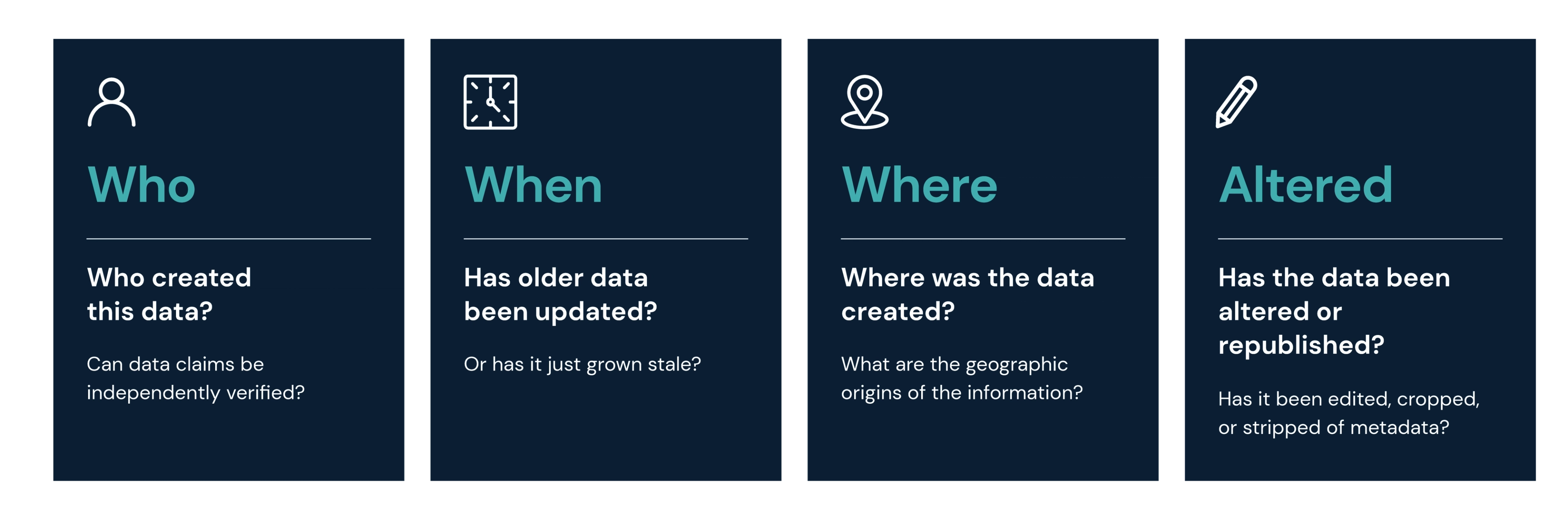
At Babel Street, qualified data and other content support this objective by helping analysts examine such critical questions as:
- Who created this data? What was its original source: a government, a single person, an established news organization, an anonymous commenter on a message board, an AI-generated web page? Can data claims be independently verified?
- When? Has older data been updated? If so, when? Or has it just grown stale?
- Where was the data created? What are the geographic origins of the information? Does it come from the most credible sources available, even if those sources are based in regions typically underrepresented by commercial datasets? Is the most valuable information available located in hard-to-access adversarial nations such as China, Iran, and Russia?
- Has the data been altered or republished? Has it been edited, cropped, or stripped of metadata?
For content to be capable of answering the questions above, it must have provenance, credibility, and relevance.
Data provenance: tracing intelligence to its source
Data provenance is the history of a data point: its origin and an accounting of the modifications made to it from creation to analysis. It helps OSINT practitioners trace information to its source and evaluate whether it has been produced by legitimate sources, criminals, unreliable contributors, or AI. In the age of AI-powered disinformation and misinformation, this traceability provides a foundation for assessing credibility.
Data credibility: evaluating intelligence source reliability
While provenance is the process of citing sources, credibility is the process of evaluating the sources themselves. An AI system may correctly cite a report of aliens landing on the White House lawn as originating from Tom’s Extraterrestrial Tribune. But the source is dubious. Credibility processes assess whether the source cited is authoritative and reliable. In doing so, these processes help separate verified information from disinformation/misinformation, hard evidence from speculation, original reports from recycled content, and authentic signals from noise.
Explainability is an important component of credibility, and part of what separates black-box AI from the types of intelligence systems that offer outputs capable of being traced, examined, and challenged. In preserving sources and their relationships to conclusions, explainable AI systems, such as Babel Street’s, empower the IC to examine conclusions reached by AI. It helps them understand and evaluate the factors contributing to those conclusions — improving defensibility.
Data relevance: improving intelligence through entity resolution
You’re an investigator researching a potential arms dealer. His name is Robert Jones. He is a British national, living in London. Your AI-powered intelligence platform returns every piece of information it can find regarding every iffy Robert Jones in the United Kingdom.
No one has time to wade through hundreds of thousands of pages of irrelevant information. It is therefore vitally important that AI-powered intelligence platforms return only information relevant to the search.
This is accomplished, in large part, through entity resolution: the process of finding and linking records referring to the same entity in and across massive, evolving data sets. By appending identifiers — age, gender, street address, email address, telephone number, family connections, employment, education, and more — to each “Robert Jones,” Babel Street’s entity resolution capabilities help analysts reduce mistaken associations and focus on records most likely to concern the Robert Jones they’re actually examining. (Similar capabilities are applied to corporate entities.)
Working with content that our AI agents have scrutinized, the Babel Street Agentic Risk Intelligence platform can help the IC, government agencies, and the military obtain better, sharper insight in such common use cases as:
- Cognitive warfare: Track information operations, narrative manipulation, and adversarial influence campaigns. Learn where and how adversarial influence operations distort reality. Uncover the people and governments responsible for these distortions.
- Cyber-threat detection: Illuminate potential cyber threats before they become imminent risks. Gain a better understanding of which organizations are likely to be targeted by cyber criminals. Learn more about the computing-infrastructure providers, corporate entities, and criminal networks used by state-sponsored cyber actors.
- Supply-chain risk management: Obtain a better, faster understanding of threats to supply chains, and the proximity of potential adversaries to critical infrastructure components, assets, and operations.
- Contested logistics: Detect and predict vulnerabilities in commercial supply chains that may expose them to aggressive geopolitical maneuvering.
- Event protection and VIP security: Rapidly identify emerging geopolitical flashpoints, physical threats, and other vulnerabilities that may affect events and VIPs.
- Facility protection: Track the normal flows into and out of facilities to learn whether anomalies could indicate a potential compromise.
- Advanced watchlist screening: Reach beyond rigid, nation-level watchlists to uncover local criminal and security risks.
How Babel Street delivers qualified data for risk intelligence
The Babel Street Agentic Risk Intelligence Platform finds and coalesces billions of pieces of qualified PAI/CAI to provide the intelligence community, government agencies, and military organizations with timely, source-backed strategic threat intelligence, identity risk intelligence, and vendor risk intelligence
The Babel Street Data Advantage underpins this technology, supplying data with all the qualities of qualified content discussed in this blog. That foundation supports an agentic workflow designed to retrieve broadly, select carefully, preserve provenance, communicate uncertainty, and retain auditable records.
At Babel Street, provenance is paramount. Understanding that the ability to trace every claim is fundamental to optimized insight, our processes preserve available source and lineage information for a data point. We trace its origin and its movement through data pipelines — preserving its history from time of collection onward. Depending on the source and collection method, this context may include transformations, translations, reposts, screenshots, or appearances on aggregation sites. We also provide audit-ready governance throughout the data lifecycle.
To ensure credibility, we use a proprietary scoring methodology evaluating the data’s point of origin and that source’s long-term reliability. In doing so, we quell data noise and surface true signals. We check against source failure: helping analysts identify content that may be inaccurate, deceptive, misattributed, or outdated.
Sometimes, the most credible information is the hardest to reach: adversarial nations may present different information to their own citizens than to foreigners.
The Babel Street Data Advantage delivers a continuous flow of curated, hard-to-reach data sourced from strategically significant regions and industries. Leveraging a secure global infrastructure, our experts collect and validate data from areas such as the Middle East, Europe, Russia, and Asia. This timely insight on intelligence and military activity, strategic shifts, security policies, and vendor risks is invaluable to the IC.
Our content-retrieval processes collect data selected for its relevance to risk. We then resolve entities, enriching them with personal, geographic, behavioral, and organizational context — and finding difficult-to-uncover connections among people, businesses, and organizations
The Babel Street Agentic Risk Intelligence Platform is a leading technology that harmonizes identity information, location information, structured and unstructured documents, deep web data, dark web data, and the connections among them. Unlike providers of many commoditized data sets — which rarely offer information such as business data, adversarial content, and social media monitoring as a comprehensive suite — we meld our qualified content into a single, curated intelligence ecosystem. This ecosystem grounds our advanced AI. Working in tandem, our qualified data and tradecraft-imbued AI agents reveal hidden risks, and their proximity to the people, businesses, locations, assets, and missions that government organizations strive to protect. In doing so, the Babel Street Agentic Risk Intelligence Platform sets a new and necessary standard for threat protection.
Frequently asked questions about data quality
Why is data quality important for intelligence analysis?
High-quality data gives intelligence analysis a more reliable foundation by helping analysts distinguish credible threat signals from inaccurate, outdated, or irrelevant information. It supports more reliable assessments, reduces false leads, and gives decision-makers a stronger foundation for action.
What is qualified data in intelligence investigations?
Qualified data is information evaluated for provenance, credibility, and relevance before use in an investigation. This evaluation helps analysts assess where information originated, how trustworthy it is, and whether it addresses the intelligence requirement.
How does unreliable data affect AI-powered intelligence?
Unreliable data can cause AI systems to produce misleading conclusions, false connections, and inaccurate threat assessments — even when outputs cite their sources correctly. Qualified data reduces these risks, but human review and model validation remain essential.
What is the role of data provenance in open-source intelligence?
Data provenance documents information’s origin and the changes made to it during collection, processing, and analysis. In open-source intelligence (OSINT), it helps analysts trace claims to their sources, examine context, and identify alterations that could affect their interpretation.
How can intelligence agencies verify the credibility of data sources?
Intelligence agencies assess source credibility by examining a source’s expertise, access to information, reporting history, and potential biases. Analysts also corroborate claims with independent evidence, check dates and original context, and document uncertainties rather than treating citations alone as proof.
What is the difference between data provenance and data credibility?
Data provenance establishes where information came from and how it has changed. Data credibility assesses how trustworthy the source and information are. A claim can have clear provenance yet remain unreliable if its source lacks credibility.
How does data relevance improve intelligence investigations?
Relevant data addresses the investigation’s specific subjects, timeframe, geography, and intelligence requirements. It reduces unrelated results, helps analysts prioritize meaningful evidence, and makes it easier to identify connections that matter to the mission.
Why is entity resolution important for OSINT investigations?
Entity resolution links records referring to the same person, business, or other entity while distinguishing similar names and identities. In OSINT investigations, it reduces mistaken associations and helps analysts connect fragmented information into a more accurate picture.
How can AI-generated misinformation affect intelligence analysis?
AI-generated misinformation can introduce fabricated reports, synthetic images, and false narratives into intelligence workflows. If accepted without verification, this content can distort assessments and create false leads. Checking provenance, corroborating claims, and evaluating source credibility help reduce these risks.
How does explainable AI improve intelligence reliability?
Explainable AI makes the evidence and factors behind an output more understandable to analysts. It supports review, helps expose unsupported connections, and allows findings to be challenged. Explainability strengthens oversight, but does not guarantee that a conclusion is correct.
What are the ODNI requirements for citing publicly and commercially available information?
Under Intelligence Community Standard 206-01, applicable intelligence products must use standardized citations and references for publicly available information, commercially available information, and OSINT. The standard specifies source-reference elements and formats, including formats for AI-assisted sources, to make sourcing and context explicit.
How can qualified data improve cyber-threat detection?
Threat intelligence tools need qualified data to help cyber-threat analysts assess whether indicators, infrastructure connections, and reported activity are credible, current, and relevant. Preserving source context and resolving related entities can reduce false leads and support more informed threat prioritization.
How does high-quality intelligence data support supply-chain risk management?
High-quality intelligence data helps organizations identify supplier ownership, hidden affiliations, geographic exposure, and potential disruption risks. Connecting credible business, trade, procurement, and location information supports more informed vendor assessments and reveals risks beyond the supplier being screened.
What is the Babel Street Data Advantage?
Babel Street Data Advantage™ is the data and contextual foundation behind Babel Street’s risk intelligence capabilities. It combines hard-to-reach global content, source qualification, entity resolution, relationship context, and provenance to help organizations understand how threats connect to their people, assets, operations, and missions.
How does the Babel Street Agentic Risk Intelligence Platform support intelligence agencies?
The Babel Street Agentic Risk Intelligence Platform combines global, multilingual data with AI-assisted investigation, entity resolution, and relationship analysis. It helps agencies uncover relevant connections, assess threat exposure, and develop traceable findings while keeping analysts responsible for interpretation and decisions.
Related Resources
You may like

White Paper
What Makes AI Research Trustworthy
An answer can be cited, grounded, and still be wrong. Trustworthy AI requires stronger evidence, better verification, and analysts who remain in control.

Data Sheet
Babel Street Data Advantage™ Overview
Reveal hidden risk through connected intelligence, entity resolution, and global data context.

eBook
The Honest Guide to OSINT Citation and Reference Standards
Ebook explaining OSINT citation standards along with examples

Blog
Better Insight Starts with Optimized Data from Babel Street
How qualified, connected data improves risk intelligence, entity resolution, AI analysis, and decision-making while reducing critical blind spots.
Endnotes
1. Office of the Director of National Intelligence, “Citation and Reference for Publicly Available Information, Commercially Available Information, and Open Source Intelligence,” December 2024, https://www.dni.gov/files/documents/ICD/ICS-206-01.pdf
2. Ibid
Published