
Babel Street Threat Investigations
Government and law enforcement agencies must act swiftly and decisively when threats emerge. From cyber intrusions to physical security breaches, the ability to investigate incidents thoroughly and in real time is critical. Babel Street empowers agencies to detect, analyze, and respond to threats with precision.
Real-time threat intelligence

Open-Source Data for Early Warning
Continuously monitor and synthesize publicly available information to identify emerging cyber and physical security risks before they escalate

Easy Access to Expansive Data
Access global, multilingual open-source data (including hard-to-reach sources) to build a fuller picture of threats, actors, and emerging trends

Automated Incident Detection
Use AI and machine learning to discern patterns, flag anomalies, and trigger alerts in real time, speeding decision making

Threat Actor Network Mapping
Analyze social media interactions, posts, and digital behavior to identify coordinated campaigns, track threat actor movements, and reveal influence patterns

Secure Collaboration
Share insights and evidence with colleagues while maintaining strict access controls and audit trails

Enhanced Predictive Intelligence
Leverage advanced analytics to anticipate future threats, forecast risk trajectories, and empower proactive decision making with actionable foresight
See it in action

Use Case
Using Babel Street to Detect and Mitigate Insider Threat
How Babel Street can help detect insider threat

Use Case
Using Babel Street to Increase Physical Security for Corporate Executives and Employees
Use case with screen shots on how Babel Street can be used for executive and employee protection

Use Case
Using Babel Street to Improve Force Protection and Military Readiness
How Babel Street can help improve force protection and military readiness

Use Case
Using Babel Street to Improve Global Situational Awareness
How Babel Street applies to global situational awareness
Explore solution components
Insights
Real-time, AI-assisted multilingual risk analysis that automates threat detection, scoring, and prioritization to uncover hidden connections, reduce exposure, and drive confident, proactive decisions
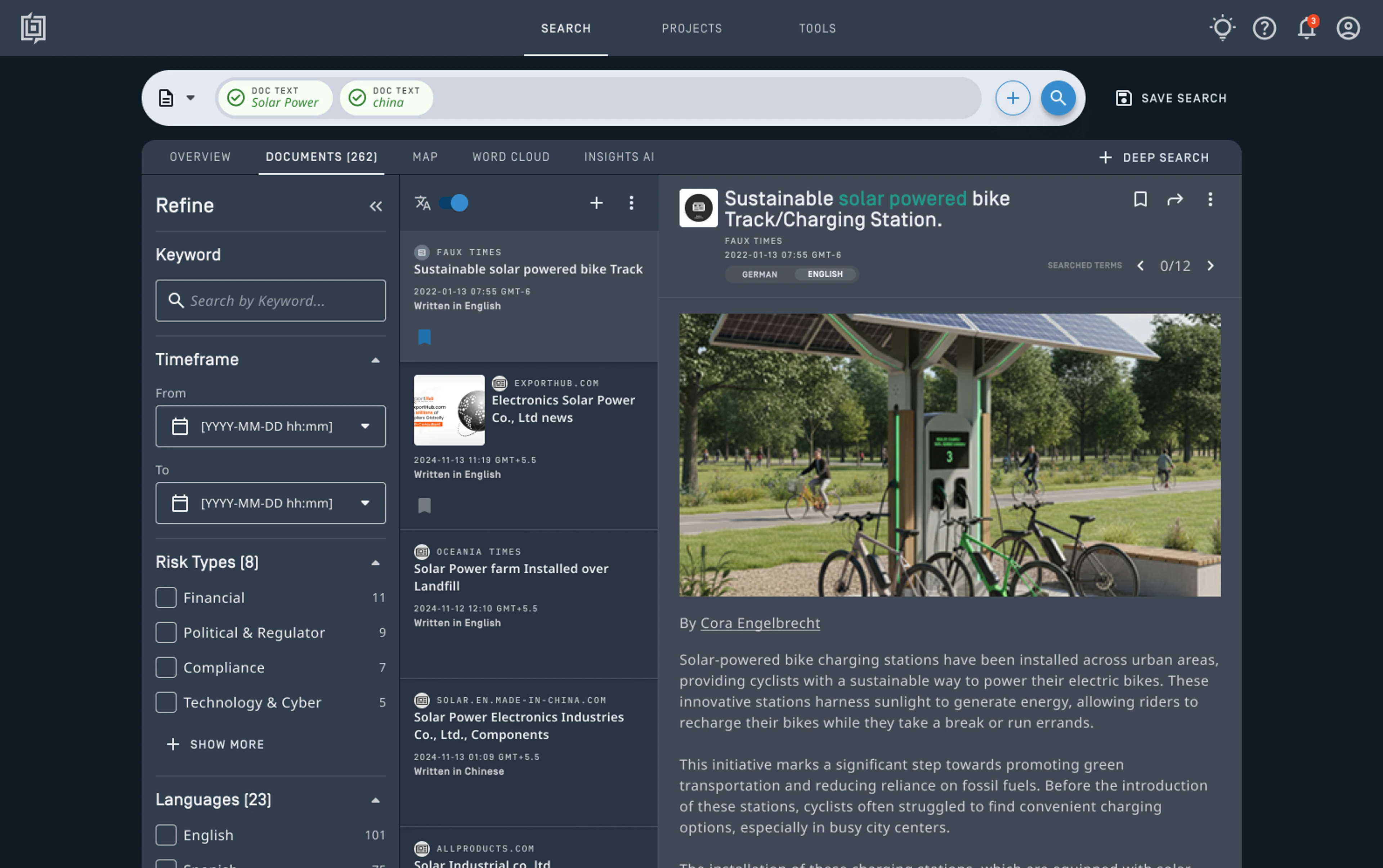
Learn more about threat intelligence solutions
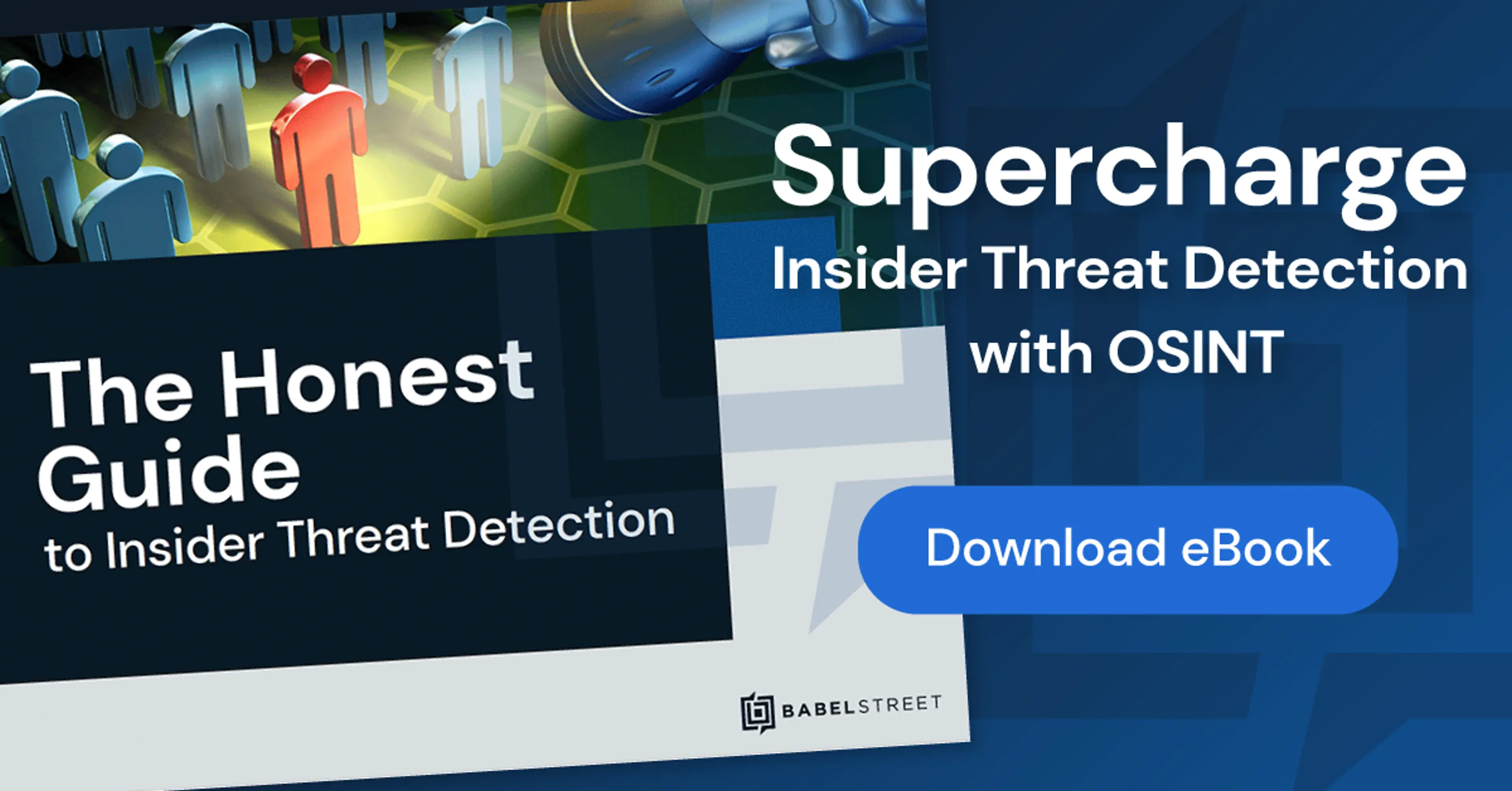
eBook
The Honest Guide to Insider Threat Detection
The value that AI-powered PAI tools can bring to the Department of War for the prevention and mitigation of data leaks and spills.

Data Sheet
Babel Street Insights Synthesis
The benefits and features of Synthesis for enhanced social network and relationship mapping

eBook
The Fundamental Guide to Managed Attribution for State and Local Law Enforcement
Educational e-book for enhancing understanding of managed attribution, particularly for law enforcement

Page
OSINT and Threat Intelligence Solutions

Speak with an expert
Frequently Asked Questions
What is insider risk management?
Insider risk management is the process of identifying, monitoring, and mitigating threats that originate from within an organization, whether intentional or accidental. It includes detecting risky behaviors, protecting sensitive data, and preventing unauthorized access or leaks. Effective programs combine policies, behavioral monitoring, and intelligence tools to reduce the likelihood of internal harm.
What are common insider threat scenarios?
Common scenarios include employee negligence (like falling for phishing attacks), accidental data exposure, credential misuse, insider fraud, intellectual property theft, and intentional data leaks. Some threats arise from weak passwords or oversharing on social media, while others involve malicious actors engaging in espionage or sabotage. These risks affect organizations of all sizes and sectors.
Why are insider threats difficult to detect?
Insiders already have authorized access to systems, making malicious actions harder to distinguish from normal behavior. Many threats stem from unintentional mistakes, which can look benign until damage occurs. Additionally, digital communication, remote work, and large volumes of unstructured data create blind spots for security teams.
How do insider risks impact organizations?
Insider risks cause financial loss, data breaches, operational disruption, compromised customer information, and severe reputational harm. In government environments, leaked or exfiltrated data can also threaten national security. Whether caused by negligence or malice, insider incidents can have long-lasting consequences across the entire organization.
What industries face the highest insider risk?
Industries handling sensitive data — such as government, defense, finance, healthcare, and technology — face the highest insider risk exposure. These sectors store valuable intellectual property, personal data, and classified information that can be exploited if mishandled. Any organization with high value digital assets or complex access privileges is vulnerable to insider risk.
How does AI detect insider risk indicators?
AI detects insider risk indicators by analyzing patterns in behavior, language, and digital activity across large volumes of unstructured data. Modern insider risk systems apply entity extraction, sentiment analysis, and violent intent detection to spot early warning signs of misconduct or data leakage. These tools surface anomalies that would be hard for humans to manually identify at scale.
What data sources are used in insider risk analysis?
Insider risk programs analyze internal logs, access patterns, email behavior, and authentication records, combined with external signals from social media, public forums, and dark web activity. OSINT sources enrich awareness of potential threats by exposing concerning behavior or affiliations outside organizational networks. This blended view helps security teams identify risks sooner.
How does OSINT contribute to insider risk detection?
OSINT expands visibility into employee activity beyond internal systems, revealing social media posts, leaked data, or public signals that may indicate elevated risk. It enables analysts to detect warning behaviors — such as grievances, hostile sentiments, or suspicious external interactions — that often appear online first. OSINT strengthens holistic risk assessments and complements internal monitoring.
What are best practices for insider risk programs?
Strong insider risk programs combine continuous monitoring, clear policies, employee education, and cross-department collaboration. Organizations should incorporate OSINT, automate alerting, and perform regular risk assessments to identify gaps. A holistic approach that includes behavioral signals, data access patterns, and external intelligence offers the greatest protection.
How do insider risk solutions reduce false positives?
Advanced insider risk tools reduce false positives by enriching data with language detection, sentiment scoring, topic classification, and relationship mapping. These signals help differentiate normal user behavior from truly concerning activity. AI filters noise and prioritizes credible risks, allowing analysts to focus on high value alerts.
What insider risk management solutions scale for enterprises?
Enterprise-scale insider risk solutions combine continuous monitoring, multilingual data enrichment, OSINT collection, and advanced analytics to detect both negligent and malicious behaviors. Babel Street provides cross-lingual, persistent search across thousands of global sources to surface early indicators of insider threats at scale. Its ability to process high volume public information in 200+ languages makes it suitable for large, distributed organizations.
How does Babel Street identify insider risk signals?
Babel Street detects insider risk signals by analyzing global PAI/CAI for indicators of suspicious behavior, sentiment shifts, data leaks, or hostile online activity linked to employees or contractors. It applies AI-driven entity extraction, sentiment analysis, and violent intent detection to highlight anomalies quickly. This allows analysts to detect warning signs long before they escalate into damaging incidents.
Can Babel Street integrate with security and HR systems?
Yes, Babel Street solutions are designed to complement existing security, HR, and compliance workflows by feeding enriched intelligence into case management or monitoring systems. This integration helps organizations unify internal activity signals with external OSINT indicators for a more holistic risk picture.
How does Babel Street support proactive threat detection?
Babel Street supports proactive detection through persistent, multilingual monitoring of public sources, revealing early signs of insider discontent, policy violations, or suspicious interactions. It highlights credible signals using automated enrichment, network analysis, and relationship mapping to surface developing risks faster than manual review. This enables organizations to intervene before issues escalate into data breaches or security incidents.
What insider risk use cases has Babel Street supported?
Babel Street has been used to detect negligent behavior, prevent data leaks, uncover malicious intent, monitor dark web exposure, and investigate corporate espionage and sabotage. Its AI-powered workflows help security teams identify threats across social media, public forums, and global sources, strengthening insider risk programs across government and enterprise sectors.