What the 2026 AI Executive Order Means for the Future of Cyber Threat Hunting


On June 2, 2026, the President issued a new Executive Order titled “Promoting Advanced Artificial Intelligence Innovation and Security.” The order establishes a national framework for integrating AI into cybersecurity and critical infrastructure protection, signaling a more coordinated and proactive approach to digital defense [1].
By formally embedding AI into the nation’s cybersecurity strategy, the order sets a new baseline for how agencies are expected to detect, understand, and address threats moving forward.
At its core, the directive pushes federal agencies to embed AI directly into cybersecurity operations to strengthen defensive capabilities, advance early threat detection, and deepen collaboration with commercial and critical infrastructure partners.
These measures reflect a broader shift in how AI is positioned within national security. AI is no longer treated as a supplementary capability, but as a central requirement for strengthening cyber defense, improving visibility, and identifying risks earlier across increasingly complex digital environments.
What was once primarily a SOC-driven function is now evolving into something much larger. Cyber threat hunting is becoming a national security priority, with AI playing a direct role in identifying threats, protecting infrastructure, and strengthening resilience across federal systems.
To support this shift, the order directs agencies to:
- Expand AI-enabled cyber defense capabilities
- Strengthen protections for critical infrastructure
- Deploy AI systems to detect and remediate vulnerabilities at scale
Ultimately, this signals a fundamental change in how cybersecurity is executed in an AI-driven world.
Shift from detection to anticipation
For a long time, cybersecurity has operated on a familiar loop: detect, investigate, respond. Threats trigger alerts, analysts step in, and action follows. The problem is that this model assumes that you’ve become aware of the attack at the right moment.
The Executive Order challenges that assumption as it leans into the idea that by the time something is detectable inside your environment, a lot has already happened outside your line of sight. That’s why the shift isn’t just toward faster detection, but instead toward earlier understanding.
Instead of:
- Focusing only on known indicators, teams are being pushed to recognize early signals of intent
- Reacting to activity, they need to understand how attacks are forming
- Waiting for entry points, they need to identify pre-attack conditions
Modern threat hunting shifts the focus from speed to timing, where success comes from identifying early signals before incidents occur. In this model, success depends on uncovering signals early enough to prevent incidents altogether.
What the government sees that enterprises often miss
The Executive Order highlights a critical gap between how organizations typically monitor threats and how sophisticated adversaries operate.
Nation-state actors operate:
- Globally, across jurisdictions and digital ecosystems
- Outside corporate visibility, leveraging platforms and infrastructure most organizations don’t monitor
Government policy acknowledges this reality. It emphasizes that threats start before intrusion, during stages like planning, coordination, and testing. Also, that effective defense must include external signals, not just internal remote monitoring.
This perspective aligns closely with how modern adversaries behave. For example, as highlighted in Babel Street’s analysis of Iranian cyber activity, nation-state threat actors frequently operate across:
- Open-source environments, using publicly available platforms to signal intent and gather intelligence
- Dark web and covert channels, where coordination, tooling, and access are exchanged
- Infrastructure pre-positioning, staging assets in advance to support future attacks against critical systems
These activities occur well before any alert is triggered inside a network, often leaving organizations with little to no visibility until later stages of an attack.
This is where the gap emerges. Most enterprise security models are optimized for what happens inside the network, while adversaries are increasingly operating outside of it. By aligning detection strategies with the full lifecycle of threat activity, including early-stage external signals, organizations can move from reacting to intrusions toward anticipating and disrupting them before they begin.
Why AI is the accelerator (not just the tool)
There’s a reason AI sits at the center of this policy shift.
The impact goes beyond efficiency, reshaping what is possible in cyber threat hunting. The Executive Order makes clear that traditional approaches cannot scale or detect threats early enough on their own. Modern threat hunting is defined by too much data, not too little, with more signals, environments, and activity than manual or rules-based approaches can manage.
AI helps bridge that gap by:
- Surfacing patterns that would otherwise go unnoticed
- Filtering out irrelevant activity at scale
- Connecting signals across different sources, behaviors, and timelines
Without AI, threat hunting often happens in bursts and is triggered by specific incidents or analyst-driven hypotheses. With AI, organizations can maintain a persistent view of the threat landscape, where signals are continuously evaluated and refined in near real time.
This transition is critical given the scale of today’s threat environment:
- Over 3.4 billion phishing emails are sent daily [2]
- In some environments, organizations face tens of thousands of automated attack probes per second [3]
At that volume, human-driven analysis alone cannot keep pace. The impact of AI in cybersecurity is already measurable:
- Organizations using AI reduce breach costs by $1.8M–$2.2M on average [4]
- AI improves threat detection efficiency by up to 1.6x compared to traditional methods [5]
AI doesn’t replace analysts, but changes the speed, scale, and depth at which they operate. This is exactly why it is so central to the Executive Order. AI is what makes continuous, intelligence-led threat hunting operationally viable, transforming it from a reactive function into a proactive, ceaseless capability aligned with how modern threats evolve.
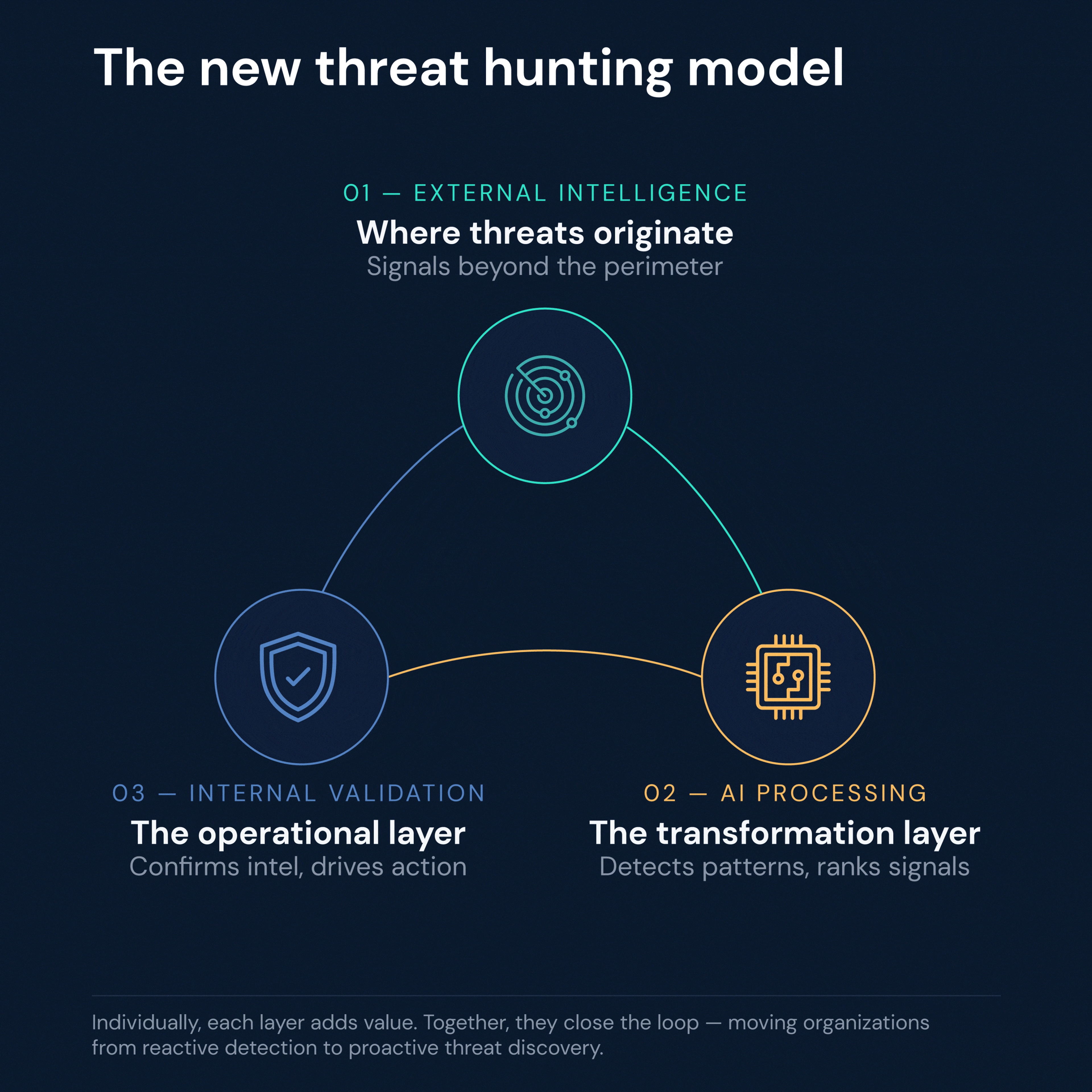
The new threat hunting model
As these trends converge, a new approach to threat hunting is emerging that reflects how threats develop.
Layer 1: External Intelligence
Visibility into where threats originate and how they evolve. This includes open-source intelligence, broader external signals, and activity occurring outside the organization’s perimeter.
Layer 2: AI Processing
The transformation layer, where large volumes of data are analyzed, patterns are detected, and meaningful signals are prioritized.
Layer 3: Internal Validation
The operational layer, where intelligence is confirmed using internal systems and translated into action through investigation and response. Individually, these layers provide value. Together, they create a continuous loop of intelligence and validation. This is what enables organizations to move from reactive detection to proactive threat discovery.
What this means for enterprises
While the Executive Order is aimed at federal agencies, it sends a clear signal to the broader market.
Organizations that fail to evolve beyond internal-only risk visibility will see slower detection times, have limited understanding of emerging threats, and will continue to face greater impacts when incidents occur. In contrast, those adopting intelligence-led approaches are better positioned to identify threats earlier, make more informed decisions, and reduce exposure to increasingly sophisticated attacks.
This shift is already evident. Cybercrime losses exceeded $16.6 billion in 2025, growing rapidly year-over-year [6]. At the same time, most organizations remain underprepared:
- 63% lack formal AI governance policies [7]
- Only 23% have structured AI security frameworks in place [8]
The result is a widening divide between organizations that rely on reactive, internal detection, and those building proactive, intelligence-driven capabilities.
Threat hunting becomes an intelligence operation
The Executive Order makes clear that cybersecurity is evolving beyond traditional operational boundaries.
We are moving toward a model where analysts spend less time triaging alerts and more time interpreting signals, as security operations begin to function more like intelligence organizations than purely reactive environments.
This shift is reinforced by broader government initiatives, including the development of shared intelligence frameworks, AI-enabled cyber defense ecosystems, and coordinated vulnerability detection efforts [9].
As a result, threat hunting is becoming continuous and embedded, rather than periodic and reactive. Security teams are increasingly thinking in terms of actors, behaviors, and patterns, instead of isolated alerts or events.
Cyber threat hunting is becoming an intelligence-driven discipline, focused on context, anticipation, and deeper situational awareness of the threat environment.
Adapting threat hunting for an AI-driven future
While the Executive Order doesn’t introduce an entirely new concept, it accelerates a shift that is already underway.
The path forward requires expanding visibility beyond internal environments, integrating external intelligence into workflows, and leveraging AI to manage the growing scale and complexity of modern threats. Organizations must build toward continuous, intelligence-driven security models rather than reactive approaches.
In this new way of thinking, threat hunting is no longer centered on identifying what has already happened, but on understanding what is taking shape across the broader threat landscape.
In an environment where attacks are faster, more automated, and increasingly coordinated, success will depend on one key capability: turning fragmented, real-time signals into actionable intelligence before they become incidents.
End Notes
1. The White House, “Fact Sheet: President Donald J. Trump Promotes Advanced Artificial Intelligence Innovation and Security,” June 2, 2026, https://www.whitehouse.gov/fact-sheets/2026/06/fact-sheet-president-donald-j-trump-promotes-advanced-artificial-intelligence-innovation-and-security/
2. StationX, “Phishing Statistics Latest Attack Data & Trends,” 2026, https://app.stationx.net/articles/phishing-statistics
3. AllAboutAI, “AI Cyberattack Statistics 2026: What the Data Warns Us About,” 2025, https://www.allaboutai.com/resources/ai-statistics/ai-cyberattack/
4. DeepStrike, “AI Cyber Attack Statistics 2025, Trends, Costs, Defense,” June 1, 2026, https://deepstrike.io/blog/ai-cyber-attack-statistics-2025
5. Programs.com, “New Report: Over 80% of Cyberattacks Now Use AI,” May 5, 2026, https://programs.com/resources/ai-cyberattack-stats/
6. Practical DevSecOps, “AI Security Statistics 2026: Latest Data, Trends & Research Report,” March 9, 2026, https://www.practical-devsecops.com/ai-security-statistics-2026-research-report/
7. BotMemo, “AI Cybersecurity Statistics 2026,” May 29, 2026, https://www.botmemo.com/ai-cybersecurity-statistics
8. Practical DevSecOps, “AI Security Statistics 2026: Latest Data, Trends & Research Report,” March 9, 2026, https://www.practical-devsecops.com/ai-security-statistics-2026-research-report/
9. The Conversation, “Trump’s AI Security Order Acknowledges Risks but Stops Short of Regulating Industry,” June 12, 2026, https://theconversation.com/trumps-ai-security-order-acknowledges-risks-but-stops-short-of-regulating-industry-284495
Published