Beyond the Perimeter: AI Threat Intelligence for Preparedness

A call comes into the control room nineteen minutes before kickoff.
Someone has seen a social post. It mentions today’s match. The language is vague, but threatening enough to make people uneasy. There is no clear identity behind it, no obvious context, and no immediate way to know whether the post is a serious warning sign or just another piece of online noise from an angry fan.
But the stadium is full. The turnstiles are moving. Thousands of people are already inside or making their way toward the gates.
In that moment, the decision facing security leaders is not theoretical. Do you hold entry? Do you escalate to police? Do you increase screening? Do you adjust stewarding? Do you communicate with staff? Do you risk panic? Do you risk doing too little?
Every option carries consequences.
And if the threat turns out to be real, every decision made in those nineteen minutes will be reviewed afterward with the benefit of hindsight. Regulators, the public, investigators, and executives will all ask some version of the same question:
What could you reasonably have known before the threat reached the doorstep?
That question sits at the heart of the new era of public security, not just at event venues, but across the spectrum of spaces where people gather in large numbers. The organizations responsible for public safety at these premises must think more systematically about how they prepare for, respond to, and reduce harm from threats. But the bigger shift is cultural and operational. The organizations that lead will not define readiness only by what happens at the perimeter. They will define readiness by how early they can detect risk, how confidently they can interpret it, and how effectively they can turn intelligence into action before the crowds gather, or a politician takes the stage, or an athlete steps onto the field.
The warning signs usually start earlier than the incident
One of the hardest truths in security is that threats often leave traces before they become visible operational problems.
The threatening post that appears days or hours in advance may not be the beginning of the story. It may be the latest signal in a pattern that started weeks earlier: a grievance, escalating language from the same account, questions about which entrances have searches, or comments in online forums that seem minor in isolation but concerning when connected.
The problem is not always that the information was hidden. Often, the information was public, findable, and relevant — but not collected, correlated, or elevated in time.
That is the difference between data and intelligence.
A single post may look like noise. A sequence of posts tied to a location, event, or individual starts to look like intent. The challenge for security teams is that they are being asked to detect those patterns across an environment that has become too large, too fast-moving, and too fragmented for manual monitoring alone.
Sports and entertainment venues already know how to manage complex physical environments. They understand crowd movement, access control, stewarding, policing, emergency response, CCTV, and command-center operations. But today’s threat surface has expanded beyond event venues to transit hubs, campuses, political rallies, fan zones, and other public gathering places, in addition to being centered on well-known individuals.
And, it has moved into the digital realm to encompass the conversations, networks, research, grievances, and coordination that can form online long before anyone acts.
In other words, the perimeter has expanded.
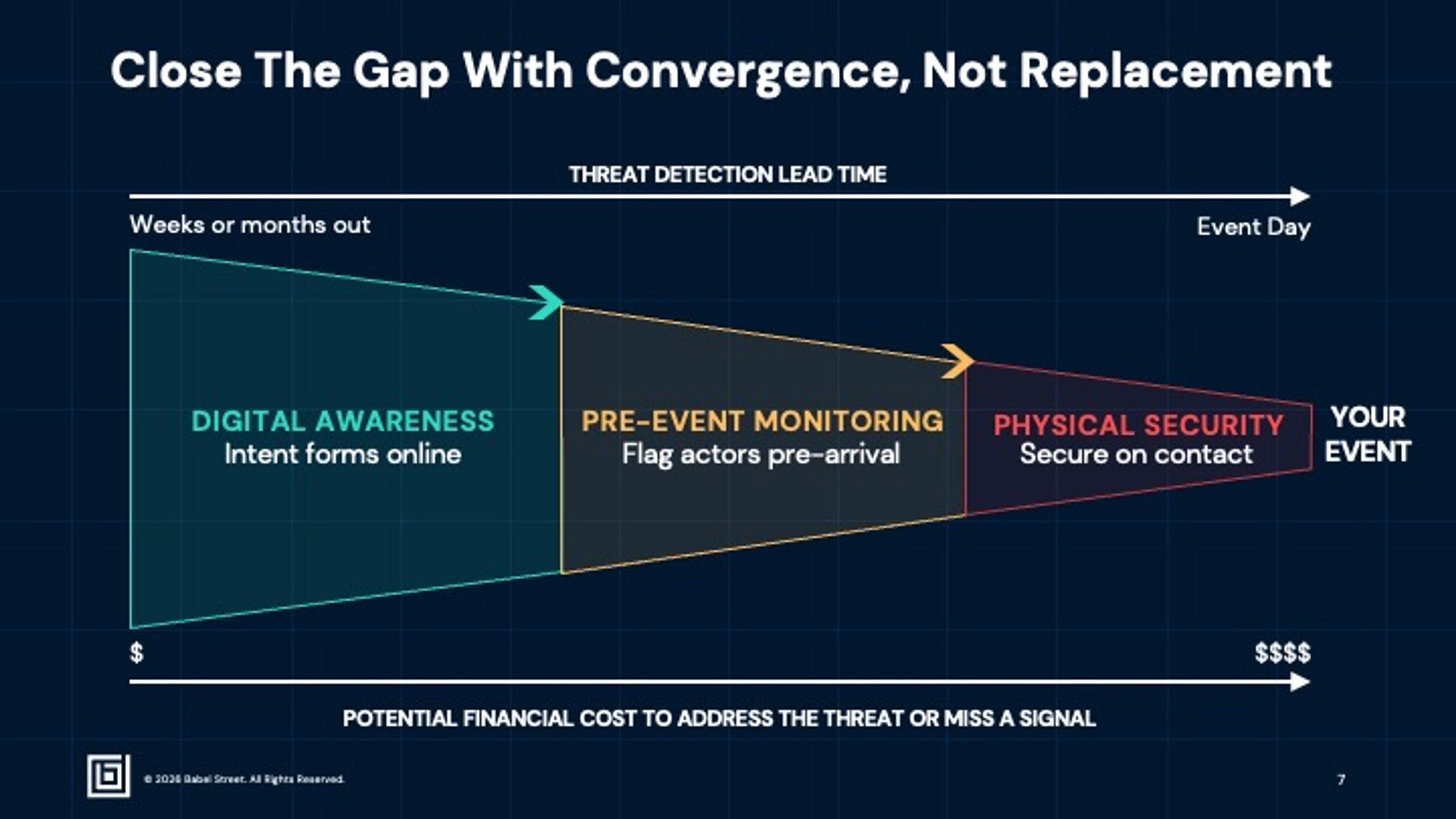
Physical security is strongest at contact. Intelligence is strongest before it.
Traditional physical security is designed to do something extremely important: provide a visible layer of protection to deter threats. But physical security is not designed to see intent forming weeks earlier.
That is where digital awareness and physical security need to converge. Digital awareness helps identify risk before it manifests into action. Physical security acts on that awareness when it matters most. The more time between detection and threat realization, the more options leaders have. That lead time can change everything — cost, coordination, confidence. It changes whether the organization is reacting under pressure or acting from preparation.
That is why the most important security question is shifting from “How do we respond if something happens?” to “How far left can we move detection before it does?”
Take preparedness seriously
Organizations can’t predict every threat. But they can take preparedness seriously, implement appropriate procedures, consider vulnerability, and be able to show what they did.
Preparedness is not just a plan sitting in a folder. It is a system of decisions. What was assessed? What did the organization know? What sources informed the assessment? What changed as new information emerged? Who reviewed it? What action followed?
When a regulator or investigator asks how a risk was understood, the strongest answer is not a scramble to reconstruct events after the fact. Rather, it’s a documented, repeatable workflow: sourced, timestamped, reviewable, and tied to operational decisions. If an organization can detect emerging risk earlier, preserve the source trail behind that risk, and show how the information informed preparedness, it strengthens both its protective posture and its defensibility.
The invisible part of the threat surface is growing
There is a reason this problem is becoming harder.
Most of the threat surface is not visible in the places that security teams have traditionally watched. Some of it sits on mainstream social platforms. Some of it is buried in forums, comment threads, fringe communities, or hyperlocal spaces. Some of it appears briefly and disappears. Some of it is behind logins. Some of it crosses languages. Some of it relates to people, vendors, suppliers, or networks that are not obvious from a single data point.
A human analyst can do extraordinary work, but no human team can manually monitor every relevant source, in every language, around every potential threat, every day of the year.
That is why AI has entered the conversation — but not all AI is equal for this mission.
Consumer AI can summarize, draft, and generate. Those capabilities are useful in the right context, but public safety intelligence requires something different — access to the right data, the ability to preserve source provenance, and the discipline to keep human analysts in control of scope, logic, and decisions.
An AI model is only as good as the data beneath it. For threat intelligence, the differentiator is whether the system can reach the sources where risk signals appear, connect weak signals across fragmented data, and present findings in a way an analyst can validate and act on.
That is the promise of agentic risk intelligence: not AI replacing judgment, but AI extending the reach, speed, and consistency of the people responsible for making judgment calls.
Agentic risk intelligence gives security teams a wider field of view
Agentic AI is most powerful when it supports three related intelligence disciplines.
The first is situational awareness and threat intelligence. Security teams need to understand what is forming around a venue, fixture, performer, executive, team, or event. That might include planned disruption, hostile reconnaissance, threats of violence, protest activity, or other indicators that could affect safety and operations.
The second is identity risk intelligence. Many threats begin with ambiguity: an anonymous account, a handle, a partial name, a disconnected post. Analysts need ways to resolve whether a person of concern is connected to other accounts, prior incidents, networks, or behaviors that change the risk picture.
The third is vendor and supplier risk intelligence. Public venues depend on complex ecosystems of contractors, caterers, technology providers, temporary workers, logistics partners, and service vendors. Those relationships can introduce financial, operational, cyber, reputational, or physical risk. A readiness program that ignores third-party exposure is incomplete.
Across all three areas, the objective is the same: convert scattered signals into decision-ready intelligence early enough to matter.
Preparedness should also be a road to maturity
Preparedness is a series of maturation steps that organizations can undertake over time.
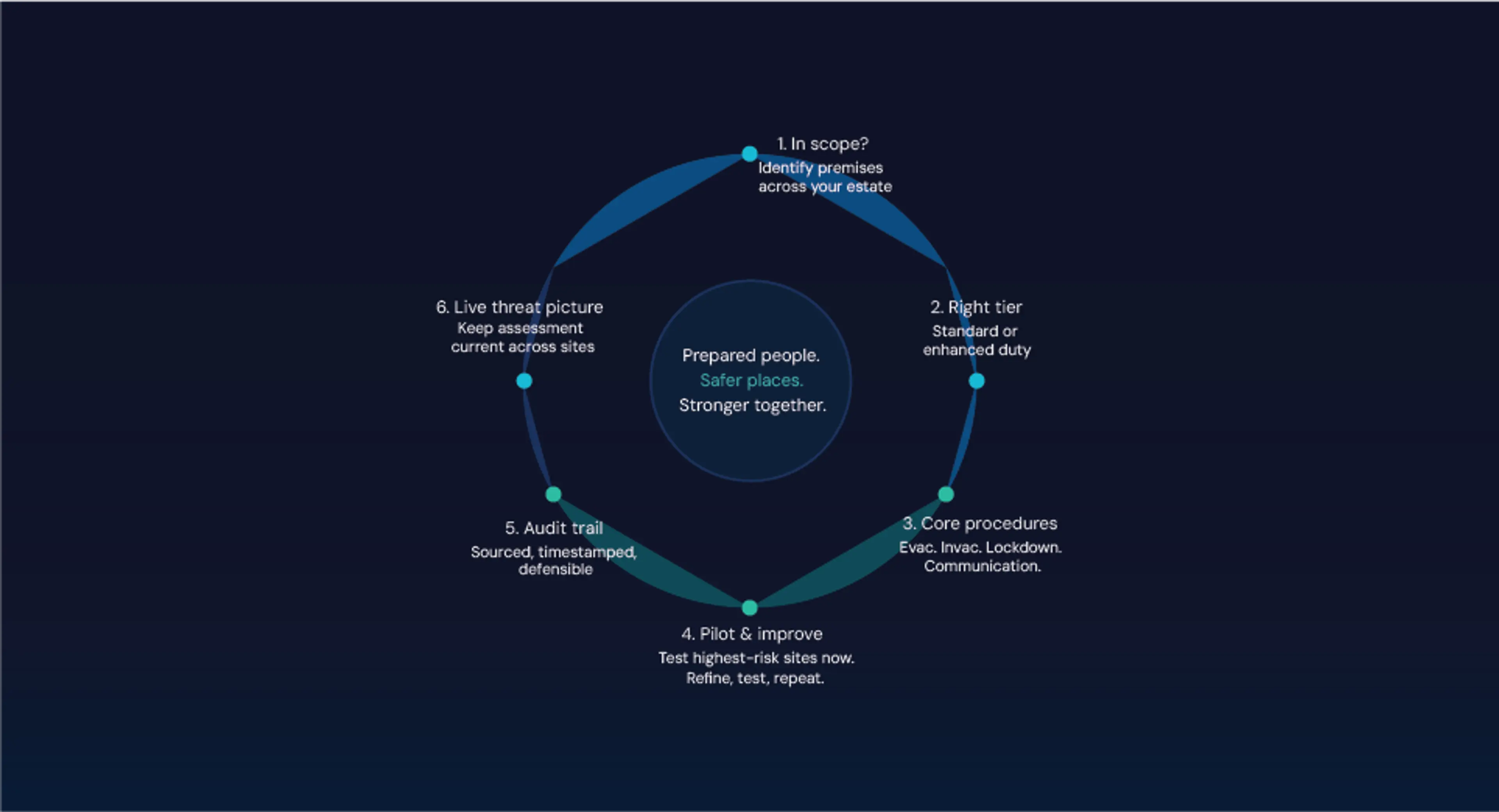
- The first step is to assess which locations, events, high-profile individuals, or infrastructure may be at risk.
- The second step is to baseline protocols against common guidance. Evacuation, invacuation, lockdown, and communication procedures are the floor. Organizations need to know where their current plans are strong, where they are inconsistent, and where digital threat awareness is missing from the operating model.
- The third step is to define intelligence requirements. For each risk type, ask a simple question: What would we want to know thirty days out? That question forces useful specificity. It turns vague concern into a collection plan. It also creates evidence of diligence.
- The fourth step is to test the process before a tragedy occurs. How are risks detected? Who reviews them? When are they escalated? What gets documented? What changes operationally?
- The fifth step is to build the audit-trail habit. If the organization identifies a risk, there should be a record of the source, the assessment, the decision, and the action. This is more than a legal liability artifact. It becomes an institutional memory for how the organization manages evolving threats.
None of this is about buying technology for its own sake. It is about moving from a reactive model to an anticipatory one.
The security teams that lead will answer the hard question earlier
Return to the control room nineteen minutes before kickoff.
The uncomfortable part of that scenario is not just the threat — it’s the uncertainty. The lack of context. The sense that the organization is being forced to make a high-consequence decision with partial information and no time.
The best security teams will not eliminate uncertainty altogether. No one can. But they can reduce the amount of uncertainty by connecting more signals, rehearsing the workflow, and documenting the decision path. They can give physical security teams better information before the gates open. The venues and public spaces that lead will not be making their first high-risk decision nineteen minutes before kickoff. They will have answered the question three weeks earlier.
Frequently asked questions
What is agentic risk intelligence?
Agentic risk intelligence is the use of autonomous AI agents to continuously identify, investigate, analyze, and prioritize risks across large volumes of data, helping organizations detect emerging threats and make faster, more informed decisions.
How does threat intelligence improve event security?
Threat intelligence improves event security by helping teams identify potential risks before they reach the perimeter. It connects digital signals, public information, and emerging patterns so security leaders can make earlier, more informed decisions about staffing, screening, escalation, and response.
Why is digital awareness important for public safety?
Digital awareness is important because many warning signs now appear online before they become physical threats. Monitoring relevant digital spaces helps organizations detect grievances, coordination, hostile intent, or misinformation early enough to assess risk and take appropriate action.
How can AI help organizations prepare for security threats?
AI can help organizations prepare by scanning large, fast-moving information environments, identifying weak signals, connecting related data points, and surfacing findings for analyst review. When paired with human judgment, AI can improve speed, consistency, and situational awareness across the threat lifecycle.
What is the difference between physical security and threat intelligence?
Physical security protects people and places through measures such as access control, screening, cameras, guards, and emergency response. Threat intelligence helps teams understand risks before they materialize by collecting, analyzing, and contextualizing information that can guide preparedness and operational decisions.
Who benefits from early threat intelligence?
Early threat intelligence benefits any organization responsible for protecting people, places, or operations, including venues, campuses, transportation hubs, public agencies, corporate security teams, commercial real estate owners, and event organizers. By identifying risks sooner, these teams gain more time to assess threats, coordinate response, and make informed decisions before incidents escalate.
Published
Related Resources
You may like
Beyond the Perimeter: Public Safety Depends on Finding Threats Before They Become Incidents
A deep dive into how risk increasingly emerges in digital spaces before becoming a real-world threat.
Martyn's Law: Preparedness Across Every Site
One law. Many places. One responsibility.

Faster Than Threats: AI-Powered Intelligence for Modern Events