

Key Takeaways
- AI risk assessment helps organizations continuously identify and evaluate emerging risks.
- AI can uncover hidden relationships between people, businesses, assets, locations, and threats.
- Proximity-to-risk intelligence provides context beyond traditional static risk scores.
- Reliable AI risk assessment depends on trusted data, entity resolution, and explainability.
- AI supports rather than replaces human analysts by helping teams prioritize emerging risks.
Risk doesn't sit still anymore
AI risk assessment is evolving from a periodic evaluation into a continuous intelligence capability. At its core, it applies artificial intelligence to identify, analyze, and monitor risk by uncovering meaningful connections across large volumes of data. Traditionally, organizations assess risk as a snapshot in time. Today, risk moves through relationships, ownership structures, geopolitical events, digital ecosystems, criminal networks, and supply chains. As a result, exposure is increasingly determined not by an organization’s direct connections, but by its indirect ones.
Because of this, organizations need visibility into proximity to risk — how closely people, businesses, assets, locations, and networks are connected to emerging threats. By continuously analyzing those connections, organizations can strengthen risk management initiatives and support more effective decision making before threats become operational consequences.
Why traditional risk assessment misses emerging exposure
Traditional risk monitoring relies on point-in-time reviews, static scoring models, and periodic due diligence processes that may fail to capture ownership changes, sanctions exposure, or newly emerging relationships. Organizations may possess relevant information but lack the ability to continuously evaluate how relationships and exposures evolve over time.
Modern AI risk assessment shifts the focus from static evaluations to understanding changing risk relationships. With an AI risk assessment platform, organizations can continuously assess how emerging developments alter risk exposure across interconnected networks instead of asking whether an entity appeared risky during a fixed review period.
From risk scores to proximity-to-risk intelligence
What Is AI Risk Assessment?
AI risk assessment is the use of artificial intelligence to identify, analyze, and monitor potential risks by connecting signals across large volumes of data, surfacing hidden relationships, and helping organizations understand how exposure is changing over time.
Risk scores remain an important component of effective AI risk assessments, but their value depends on the intelligence and context behind them. Exposure is rarely driven by a single attribute. Instead, it is shaped by relationships, behaviors, locations, business affiliations, digital activity, and external events that may influence an entity's proximity to risk.
AI can identify relationships that would otherwise remain fragmented across datasets, intelligence sources, and time periods, helping analysts understand how risk traverses complex ecosystems. By continuously analyzing these connections, AI helps organizations move beyond isolated risk indicators and toward a more complete understanding of their proximity to risk.
This broader perspective shifts risk assessment from “What risk is associated with this entity?” to “How is this entity connected to risk, and how is that exposure changing over time?” The result is a stronger foundation for risk scoring, prioritization, and action, allowing organizations to identify emerging exposure earlier and make more confident decisions before threats escalate.
For example, AI may detect:
- Gradual changes in movement, communication, or activity patterns
- Unusual concentrations of discussion around a specific topic or location
- Emerging trends that suggest increasing instability or disruption
- New indicators that have historically preceded adverse events
- Behavioral shifts that signal growing operational, security, or compliance concerns
Rather than replacing analysts, AI helps surface patterns of acceleration, convergence, and amplification so teams can focus resources where they matter most. This enables AI risk management programs to move from reactive investigations to proactive threat awareness.
How AI expands the risk assessment field of view
Effective risk analysis depends on context. Even when organizations have reliable intelligence, important factors influencing exposure often exist outside the immediate scope of an assessment. AI helps illuminate proximity to risk through various dimensions: entity risk, business risk, location and event risk, digital risk, and temporal risk.
Together, these perspectives help organizations understand hidden affiliations, ownership structures, geographic disruptions, online narratives, sanctions activity, and emerging relationships. Collectively, these capabilities enable AI investigation tools and AI powered data analysis to provide a multidimensional view of risk.
The data foundation behind effective AI risk assessment
The effectiveness of any AI risk assessment solution ultimately depends on the quality and reliability of the information it analyzes. Even the most advanced AI models can only generate meaningful insights when they are supported by trusted, relevant, and well-structured data. The challenge is not simply collecting more data but transforming fragmented information into intelligence that reflects real-world relationships, context, and exposure. To achieve that, organizations need a strong data foundation capable of connecting signals across multiple sources and domains.
Foundational capabilities such as entity resolution, relationship context, trusted intelligence, and source quality are essential.
Relevant and reliable data helps organizations:
- Connect fragmented signals
- Reveal hidden relationships
- Provide contextual intelligence
- Clarify proximity to risk
Rather than forcing analysts to manually reconcile disconnected information, AI risk assessment solutions help create a more complete and usable intelligence picture. They help establish the context needed to understand why a signal matters, how reliable it is, and whether it warrants further attention.
For national security and government organizations, these capabilities can significantly enhance situational awareness. AI can support activities such as foreign influence monitoring, threat actor identification, geopolitical risk awareness, and open-source intelligence collection. By bringing together relevant information from multiple intelligence sources, AI helps analysts build a more complete understanding of complex situations and identify developments that may require further investigation.
In commercial environments, AI strengthens business risk programs by providing greater insight into suppliers, third-party relationships, and operational dependencies. Organizations can more effectively evaluate supplier intelligence, monitor third-party risk, and strengthen operational resilience by identifying issues that may affect business continuity or compliance obligations.
Ultimately, AI enables analysts to work more efficiently by reducing the time required to organize and assess information. The result is faster access to relevant intelligence, better prioritization of potential risks, and more confident AI-informed decision making across both security and business environments.
The future of AI risk assessment is proximity-to-risk illumination
Solutions such as those offered by Babel Street demonstrate the growing importance of combining multilingual intelligence collection, relationship analytics, and explainable AI within broader AI risk management systems. Modern AI risk management software should help organizations understand how risks connect, why they matter, and what action should be taken next.
Risk intelligence is most valuable when it helps organizations see beyond individual events and understand the broader factors influencing exposure.
Increasingly, this includes proximity to risk; the relationships, affiliations, locations, events, and networks that connect an organization to emerging threats.
Organizations that can turn data into intelligence and intelligence into action gain a significant advantage. With greater visibility into proximity to risk, they can identify emerging concerns sooner, allocate resources more strategically, and support faster, more confident AI-informed decision making in a rapidly evolving environment.
Frequently asked questions
How does AI improve threat intelligence and risk analysis?
AI improves threat intelligence and risk analysis by connecting fragmented data, surfacing hidden relationships, and helping analysts prioritize credible threats. It supports faster situational awareness, stronger risk intelligence, and more confident decision making.
What should a risk assessment framework include?
A risk assessment framework should define what is being assessed, map relevant entities and relationships, analyze risk signals, evaluate proximity to risk, and prioritize action based on evidence and confidence.
Why does explainability matter in AI risk assessment?
Explainability matters in AI risk assessment because organizations need to understand, verify, and defend the conclusions behind investigations, compliance decisions, and security actions. Strong explainability includes source attribution, confidence scoring, provenance, and auditability.
What should you look for in an AI risk assessment tool?
An AI risk assessment tool should help organizations collect relevant intelligence, resolve entities, map relationships, analyze proximity to risk, and explain results through source provenance and human review workflows.
How do AI investigation tools support intelligence and law enforcement agencies?
AI investigation tools help intelligence and law enforcement agencies connect fragmented data, uncover hidden relationships, and prioritize credible threats. They support faster investigations by surfacing relevant entities, locations, networks, and risk indicators for analyst review.
How do AI investigation tools help identify financial crime and illicit networks?
AI investigation tools help identify financial crime by mapping relationships among people, businesses, assets, transactions, and digital signals. This can reveal suspicious patterns, hidden ownership links, sanctions exposure, and connections to illicit networks.
How can AI improve risk assessments for supply chain security?
AI improves supply chain risk assessment by monitoring suppliers, ownership structures, geographic exposure, and emerging disruptions across interconnected networks. This helps organizations detect vulnerabilities earlier and strengthen supplier due diligence, compliance, and resilience.
How can enterprises use AI risk assessments to improve operational resilience?
Enterprises can use AI risk assessments to identify operational dependencies, monitor third-party exposure, and detect emerging threats before they disrupt business continuity. AI helps teams prioritize risks, allocate resources, and respond more confidently.
How do AI-powered data analysis and risk assessment improve decision making?
AI-powered data analysis improves decision making by turning large, complex datasets into timely risk intelligence. It helps leaders understand exposure, compare priorities, and act on evidence with greater speed and confidence.
How is AI risk assessment used to strengthen national security?
AI risk assessment strengthens national security by helping analysts detect threat actors, monitor geopolitical developments, and connect signals across open-source and intelligence data. It improves situational awareness and supports faster, evidence-based action.
What role does AI risk management play in protecting critical infrastructure?
AI risk management helps protect critical infrastructure by identifying threats, dependencies, and vulnerabilities across physical, digital, and supply chain environments. It supports early warning, prioritization, and coordinated response to reduce operational risk.
Published
Related Resources
You may like

Turn Visual Content into Investigative Intelligence

Exceeding Human Potential with Agentic Investigations
ノイズを迅速に意思決定につながるインテリジェンスへ変換
重要な意思決定を支える調査業務向けに設計。断片化し急速に変化するデータを実行可能なインテリジェンスへ変換します
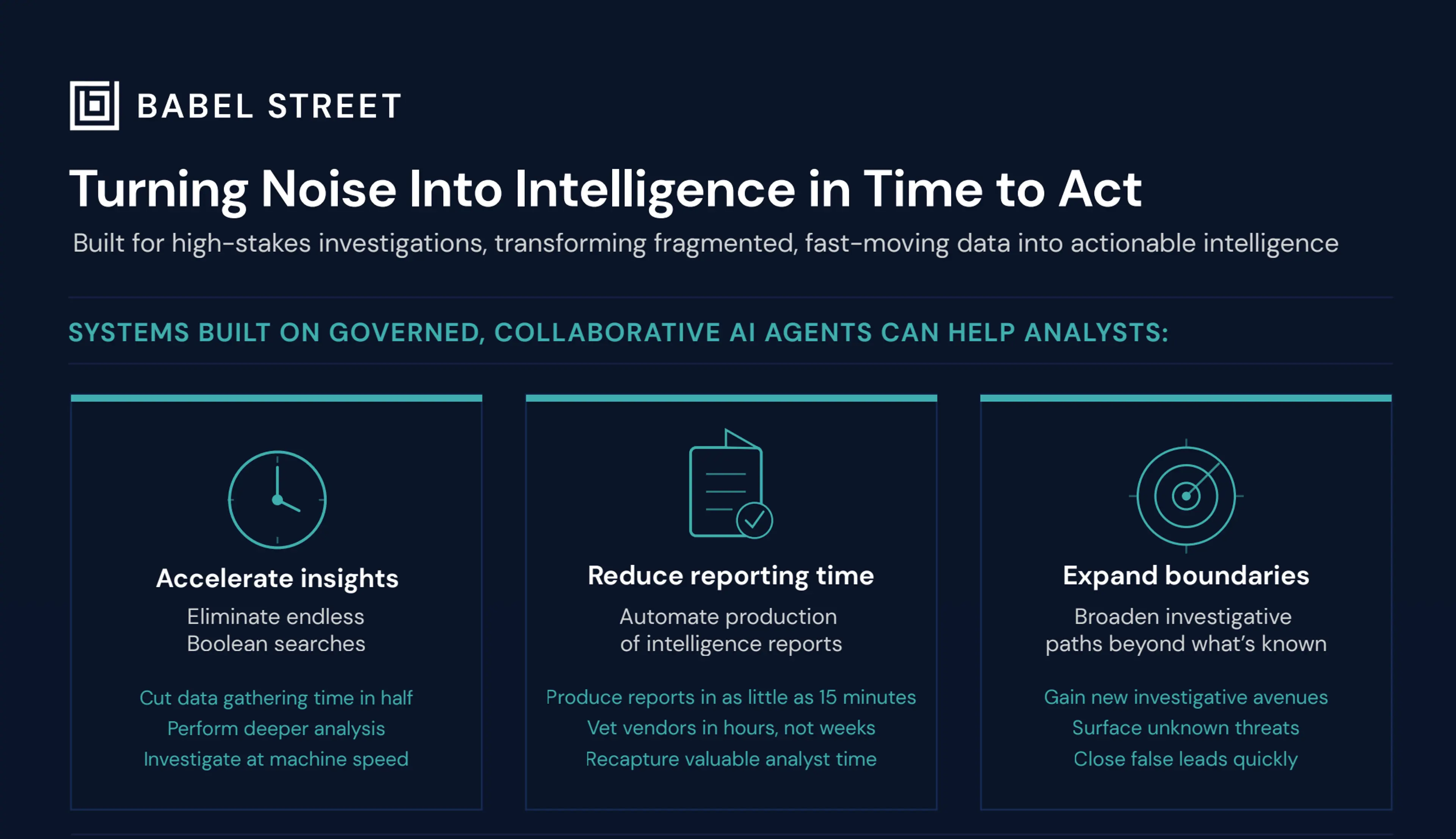
Turning Noise into Intelligence in Time to Act
Turn overwhelming data into actionable intelligence. Learn how organizations can filter noise, identify critical signals, and make timely, informed decisions.