Overcoming Siloed Fraud Detection: A Unified Strategy for State and Local Agencies

State and local agencies are on the front lines of fraud prevention — administering benefits, processing payments, detecting provider kickbacks or billing schemes, and safeguarding public funds. Yet fraud rarely respects organizational boundaries. It cuts across departments, systems, and jurisdictions, often exploiting the very silos agencies rely on to operate.
The result: even well-resourced teams struggle to connect the dots.
Most agencies today rely on a patchwork of tools — identity verification at intake, case-by-case investigations, and occasional external checks. But fraud rarely unfolds in a single step. It evolves across a lifecycle, beginning with identity manipulation, expanding into coordinated activity, and surfacing signals far beyond internal systems.
To keep pace, agencies need a unified approach that reflects how fraud operates.
At Babel Street, we organize this challenge into a three-layer model for comprehensive fraud prevention, aligned to the real-world fraud lifecycle.
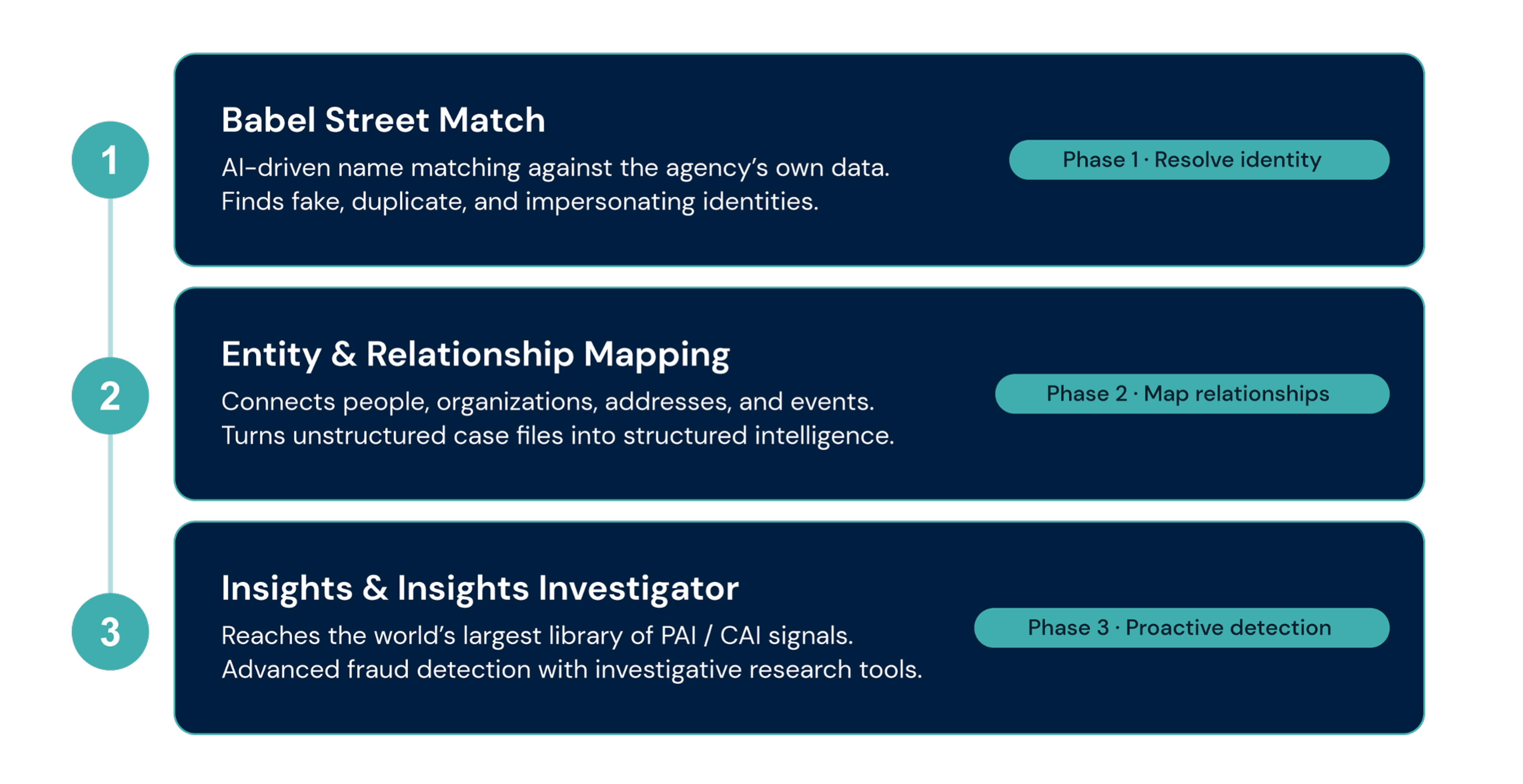
Layer 1: Resolve identity at the point of entry
Fraud often begins with identity manipulation, using stolen or fabricated personal information to gain access to government systems.
During the COVID-19 pandemic, this vulnerability was exposed at unprecedented scale. In Maryland alone, officials uncovered more than 47,500 fraudulent unemployment claims totaling over $500 million, many of which were filed using stolen personal data.[1]
These schemes exploited weak identity validation at intake, where thousands of claims tied to duplicated or synthetic identities were submitted before agencies could intervene.
Babel Street Match addresses this challenge by applying AI-driven name matching against an agency’s existing data to identify:
- Duplicate or near-duplicate identities
- Synthetic identities constructed from partial information
- Individuals attempting to impersonate legitimate applicants
Instead of treating each application as a standalone record, this approach surfaces hidden similarities across records to stop fraudulent identities before they scale into systemic loss.
Fraud prevention starts with ensuring that one real person corresponds to one verified identity.
Layer 2: Reveal the network behind the activity
Even when fraudulent identities are flagged, the real risk often lies in the network behind them.
Modern fraud is increasingly organized. Groups coordinate activity across programs, reuse infrastructure, and distribute claims to avoid detection. According to the U.S. Government Accountability Office, organized groups have been responsible for large-scale fraud in public programs, often leveraging stolen identities and coordinated tactics.[2]
A recent federal case illustrates how these networks operate: individuals used more than 100 stolen identities to create fraudulent benefit “households,” linking multiple claims to just a few shared addresses across multiple states.[3]
From a single-application perspective, each claim might appear legitimate. But viewed collectively, clear patterns emerge:
- Shared addresses
- Reused identities
- Coordinated submissions across jurisdictions
- Do not pay flags in other program data records
Entity and Relationship Mapping transforms fragmented case data into structured intelligence by linking people, organizations, addresses, and transactions, allowing investigators to move beyond isolated cases and uncover:
- Fraud rings operating across multiple claims
- Collusion and coordinated behavior
- Shared infrastructure that indicates systemic abuse
Fraud is rarely isolated — understanding relationships is essential to exposing the full scheme.
Layer 3: Extend detection beyond internal data
Even with strong identity controls and internal network analysis, agencies are still limited if they rely only on their own data. Fraud actors operate across digital ecosystems, leaving signals in places traditional government systems cannot see.
In a recent investigation in Minnesota, authorities launched a large-scale fraud probe into childcare subsidy programs after external evidence — including widely viewed online video — revealed facilities appearing inactive while receiving millions in public funds.[4]
This case underscores a critical reality: key fraud indicators may exist outside official systems and only emerge through external signals.
Similarly, government watchdog agencies warn that fraudsters increasingly exploit social media and digital platforms to impersonate programs, promote fraudulent opportunities, and reach victims.[5]
Babel Street Insights Investigator extends agency visibility beyond internal datasets by incorporating publicly and commercially available information (PAI/CAI), enabling:
- Detection of emerging fraud patterns outside agency systems
- Identification of digital signals linked to bad actors
- Broader situational awareness across jurisdictions
This allows analysts to validate internal findings and uncover risks that would otherwise remain invisible.
You cannot detect what you cannot see so external intelligence is essential for proactive fraud detection.
A lifecycle approach to fraud detection
When combined, these three layers align directly to how fraud unfolds in the real world:
- Resolve identity to prevent fraudulent entries
- Map relationships to expose coordinated activity
- Incorporate external intelligence to detect broader patterns
Time and again, high-profile fraud cases follow this pattern, starting with identity abuse, expanding into networks, and ultimately requiring external signals to fully uncover.
Designed for the realities of state and local government
State and local agencies face distinct constraints, including budget limitations, legacy infrastructure, and siloed data environments. A modular approach where each layer can be deployed independently becomes critical. It’s especially important that capabilities can be added on top of existing systems, instead of replacing them.
Fraud is no longer confined to isolated transactions or systems. It is coordinated, adaptive, and increasingly persistent. To keep pace, agencies need more than point solutions — they need a connected strategy that supports a phased implementation across the full fraud lifecycle.
By resolving identities, mapping relationships, and incorporating external intelligence, state and local organizations can move from reactive case management to holistic, proactive detection.
The result: stronger program integrity, reduced losses, and greater trust in the systems that serve the public.
Endnotes
1. Maryland Department of Labor / U.S. Department of Labor Office of Inspector General, Maryland Department of Labor Uncovers Massive Criminal Fraud Scheme, July 15, 2020, https://oig.dol.gov/public/Press%20Releases/Maryland%20Department%20of%20Labor%20Uncovers%20Massive%20Criminal%20Fraud%20Scheme.pdf
2. U.S. Government Accountability Office, Fraud Risk in Federal Programs: Continuing Threat from Organized Groups Since COVID-19, July 10, 2025, https://www.gao.gov/assets/gao-25-107508.pdf
3. U.S. Department of Justice, Four Charged in Multi-State SNAP and PUA Fraud Conspiracy, February 3, 2026, https://www.justice.gov/usao-ma/pr/four-charged-multi-state-snap-and-pua-fraud-conspiracy
4. NewsNation, Feds launch massive taxpayer fraud probe in Minnesota after viral video, December 30, 2025, https://www.newsnationnow.com/crime/fed-taxpayer-fraud-probe-minnesota-video-expose/
5. U.S. Department of Housing and Urban Development Office of Inspector General, Publications for the Public and Program Participants – Social Media Scams Advisory, June 7, 2023, https://www.hudoig.gov/sites/default/files/2023-06/Social%20Media%20Scams%20-%20Fraud%20Bulletin.pdf
Frequently asked questions
What is siloed fraud detection?
Siloed fraud detection occurs when agencies use separate tools or systems that do not share data or insights, making it difficult to see the full scope of fraudulent activity. In this model, identity checks, investigations, and intelligence gathering happen in isolation, preventing teams from connecting related cases, identifying patterns, or detecting coordinated fraud across programs or departments.
How do state agencies detect organized fraud?
State agencies detect organized fraud by combining identity verification, data analysis, and investigative techniques to uncover coordinated activity across multiple cases. This includes identifying duplicate or synthetic identities, analyzing shared attributes such as addresses or financial accounts, and mapping relationships between individuals and entities. Increasingly, agencies also rely on cross-agency data sharing and external intelligence sources to detect fraud networks that operate across jurisdictions.
What is identity resolution in fraud detection?
Identity resolution is the process of determining whether multiple records refer to the same real-world individual or entity. In fraud detection, it is used to identify duplicate applications, synthetic identities, or impersonation attempts by analyzing variations in names, addresses, and other identifying data. Effective identity resolution helps agencies prevent fraud at the point of entry by ensuring that each identity is unique and legitimate.
What is relationship mapping?
Relationship mapping is the process of analyzing and visualizing connections between people, organizations, locations, and transactions to uncover patterns of activity. In fraud investigations, it helps identify hidden links between cases — such as shared addresses, repeated contacts, or coordinated claims — making it possible to detect fraud rings, collusion, and organized schemes that would be difficult to identify through isolated case reviews.
Why is external intelligence important for fraud investigations?
External intelligence is critical for fraud investigations because many fraud signals exist outside internal government systems. Publicly and commercially available data, such as online activity, digital footprints, or open-source information, can reveal emerging schemes, validate suspicious behavior, and expose connections across jurisdictions. Incorporating external intelligence enables agencies to move from reactive case handling to proactive fraud detection.
Published